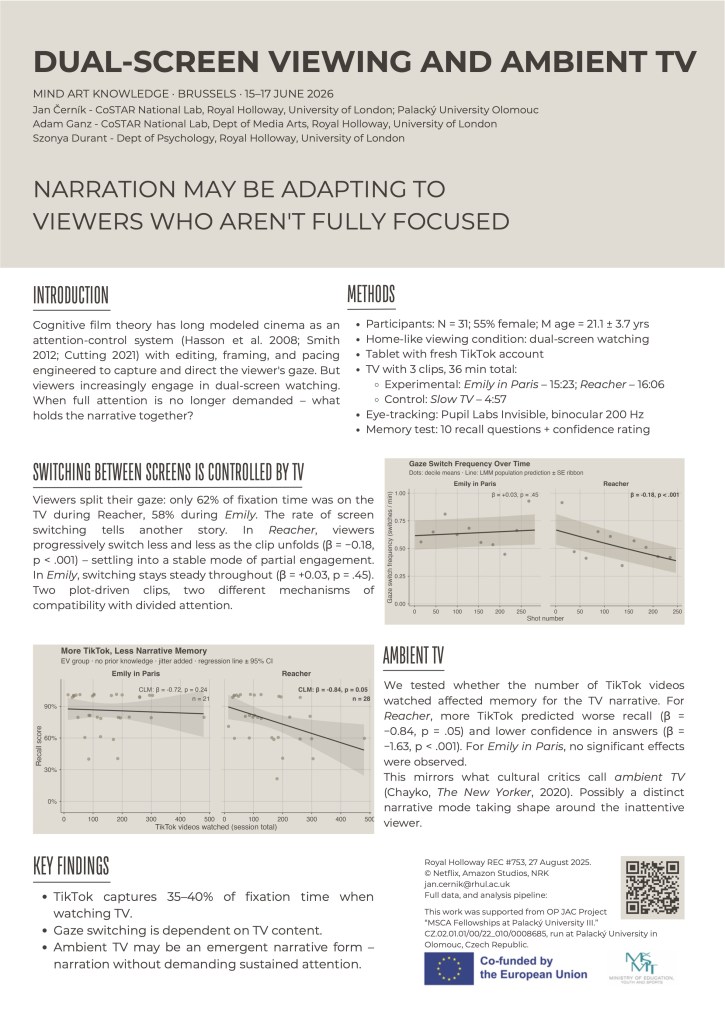
Recently, I had the opportunity to attend the Mind Art Knowledge conference, where I presented our latest research on dual-screen watching.
The core focus of our poster is the emergence of “ambient TV.” Until now, ambient TV has mostly been treated as a neat concept in cultural journalism. In our poster, we proposed a concrete, empirical way to actually test this phenomenon.
Because we presented it in a poster format, we intentionally leaned into the medium to make it a bit of a provocation…
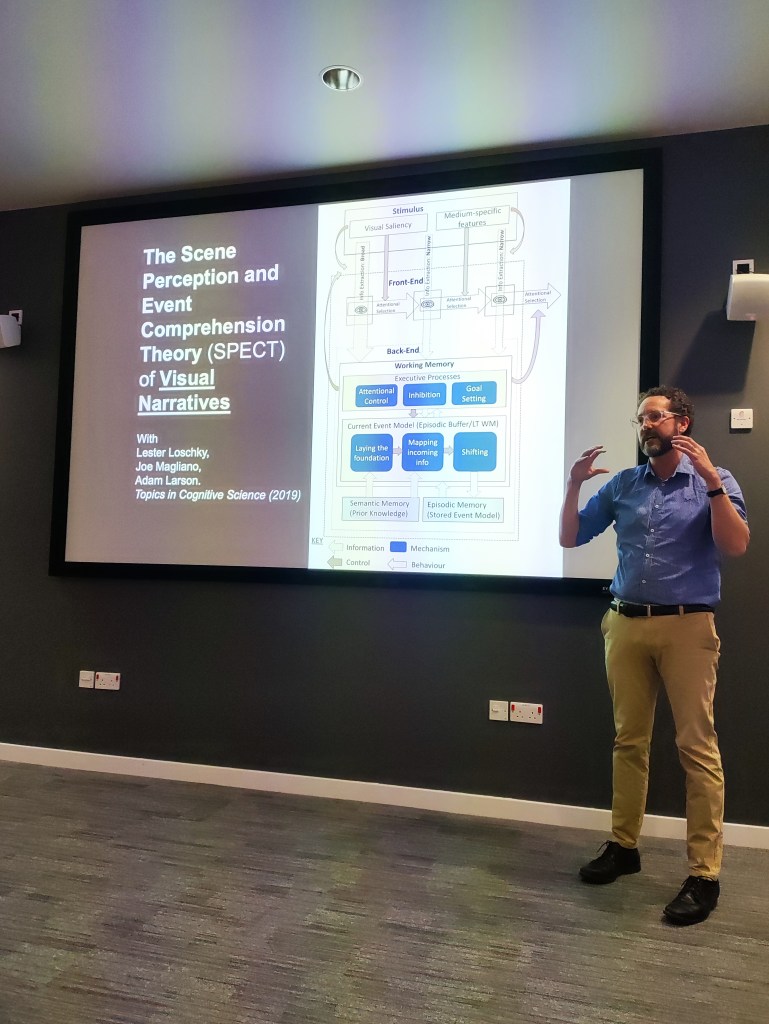
Yesterday, I was lucky to visit the Creative Computing Institute (CCI), and specifically Tim Smith‘s team, at the University of the Arts London. Tim invited me to give a short presentation about the research I am conducting at Royal Holloway under the supervision of Adam Ganz and Szonya Durant. Besides that, Tim showed me their facilities, and we had a talk about computer vision in cinema research.
In my talk, I presented a selection of the most interesting findings from the last 18 months: a) the difference between watching videos in vertical and horizontal frames, b) a null result regarding the effect of screen time on gaze patterns (both soon to be published in Projections), c) how people simultaneously watch narrative stimuli on TV and TikTok on a tablet (article just before submission), and d) which formal elements of narrative stimuli pull visual attention from a tablet to a TV screen (what I am working on). My main argument was that, contrary to my initial assumption, TikTok (and short video platforms in general) is probably not changing how we watch films. Rather, short videos (among other things) have made us aware of the audience’s inattentiveness. However, the fact that people are distracted is not new and it was always like that. It is just more visible now.
On a personal level, it was amazing to see the Creative Computing Institute and how Tim approaches research in the arts and humanities. I know very well from CoSTAR that arts research can look very different from what I was trained in. The CCI combines research activities with teaching, and it is inherently interdisciplinary. Truly, one can hardly say where one discipline ends and another begins. An illustrative example was when Tim showed me how they connected a virtual production studio with fNIRS and used it in a dance performance. The dancer’s brain activity produced a visualization on the LED panels behind him. This single example clearly shows how art can merge with neuroscience, technology, and programming, proving that these disciplines are not only communicating but also mutually beneficial.
During November, I visited several colleagues at various universities in England and while travelling by train, I read Adam Nixon’s book. Prestigious British universities and no-budget filmmaking – you may wonder why I would connect the two, but I will show you that there is a connection.
Nixon’s book is one filmmaker’s reflection on how filmmaking has changed and a report on the possibilities of film with virtually no budget. His perspective fascinates me. He is able to think about audiovisual culture in a very broad sense. In the preface, he prepares the reader for the fact that the best film of the present day may not be the work of a professional crew, let alone a film studio. We may already be living in an era where the best films are made on TikTok.
“Imagine an unknown artist is producing the best film of the current era right now. They are creating it outside centers of power, using a cheap camera with little expense. Cineastes are waiting to discover it. The question is, where will they find it? Will it debut on TikTok, Instagram, or at one of the thousands of fringe film festivals that dot the globe? The anticipation of this discovery keeps the cinema world exciting and ever evolving.” (p. viii)
Nixon’s experience as a film school teacher shows how the situation and function of schools in my field have changed. Whereas in the past they were places where students could access the best filming technology, today everyone has a 4K camera in their pocket. Access to technology alone does not make it easier to make a film. (Let’s leave sound aside.) This attitude is very similar to what my colleague from Olomouc, Tomáš Jirsa, says—students don’t go to school because of the availability of technology and don’t expect us to teach them how to use it. They have other reasons.
Nixon’s perspective shed a completely different light on what I saw at the workplaces I visited. Paolo Russo at Oxford Brookes University showed me around the campus, showed me the facilities, and we briefly discussed the technology available to their students. With Murray Smith at the University of Kent, we discussed his recent experience with interdisciplinary research and its applicability in teaching. Ceylin Ertekin from the London School of Economics showed me around their eye-tracking lab. Deborah Klika from the University of Greenwich gave me a tour of their studios, including virtual production. And everywhere I went, I thought to myself that it would take us a very long time to catch up in Czech film and humanities departments in general.
Nixon’s book puts this into a different perspective. Thanks to smartphones, we all have a camera in our pocket (in new iPhones, even with an eye tracker). Thanks to TikTok and YouTube, we all have access to a global audience. The democratization of technology may have completely redrawn the field in which we operate. The best Hollywood producers are suddenly meeting amateurs, and gatekeepers are losing power.
Don’t get me wrong. I still think technology is essential. The fact that Royal Holloway and the University of Greenwich have virtual production studios means that they have enormous opportunities in terms of research. The excellent sound technology at Oxford Brookes University offers unparalleled opportunities for their students, even if they use it to shoot on their phones. But if we stick to the educational dimension and student expectations, Nixon is probably right and access to the latest technology is not essential. After all, the best films are already being made for TikTok.
For me, Nixon’s book is mainly an inspiration to rethink what film studies are for and what their place is in today’s education system.
After six months of work on this project, I finally have my first set of data. In this post, I want to reflect on what these data might tell us about people’s relationship with TikTok—and what they reveal about how we study the perception of this platform. It’s not just about what the data show, but also how we interpret them and what questions we should be asking next.
In my initial experiment, I collected valid data from 28 participants. Each participant watched the same set of videos on a computer with eye-tracker, presented in two formats: landscape and portrait. Before every session I made a note of participants’ screen time (TikTok, Instagram, and YouTube) – not through self-reporting, but by directly checking the screen time data on their phones.
After processing and analysing the data, we obtained interesting information about differences in fixation entropy, saccade directions, and, in general, the relationship between video format and stylistic elements in the context of perception. We are preparing academic outputs on all of this. But what surprised me the most was something else.
We were unable to measure any convincing effect of screen time on the way videos are watched. It even makes me rethink some of my hypotheses. But let’s take it step by step.
To be honest, I did find one statistically significant correlation. And it’s one that deserves a headline in the newspapers: TikTok makes you less focused when watching movies!
Sounds serious, right?
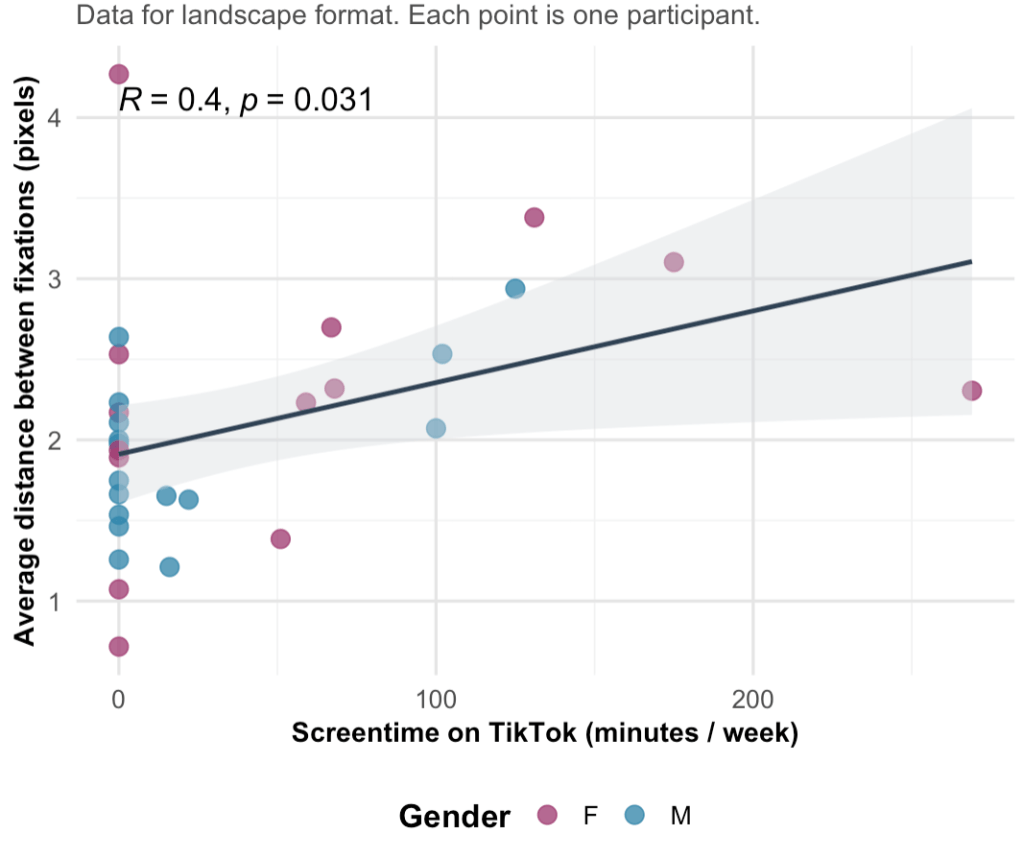
More precisely, we found that participants with higher average screen time on TikTok have a greater distance between fixations when watching landscape videos. In other words, if you watch a lot of TikTok and then watch a movie, your eyes will jump around more than the eyes of people who don’t watch TikTok.
Does it still sound serious?
Take a look at the graph illustrating this effect. The p-value even shows that the effect is statistically significant.
Does it sound even more serious now?
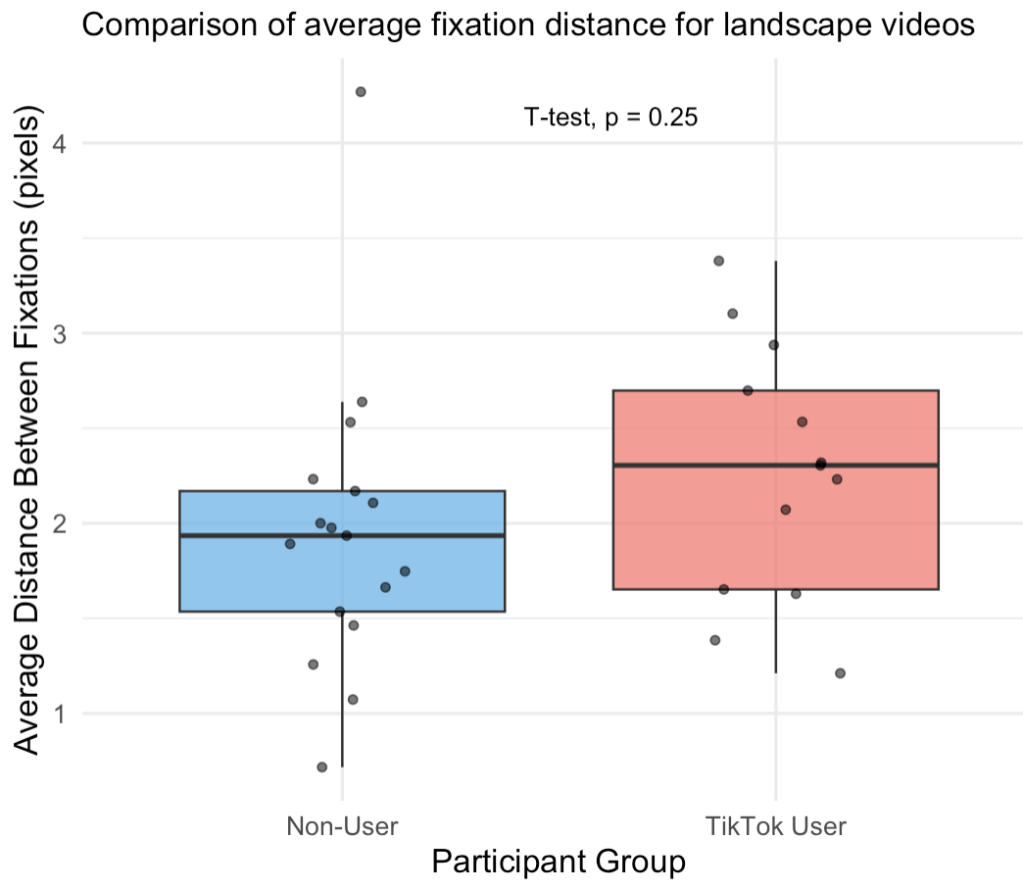
Notice the dots on the y-axis that have zero screen time on TikTok. Let’s try visualizing the data differently to get two groups: TikTok users and non-users.
And suddenly, the effect is gone. Or at least it is so small and statistically insignificant that nothing can be said with certainty on its basis.
What happened?
Imagine that you collect a huge amount of data (fixations, saccades, pupil diameters, blinking… in the spreadsheet with more than 100 columns and calculate metrics such as entropy, dispersion…) and add to it other data from a questionnaire (age, gender, average screen time…). Then you just try to look for what correlates with what until you find that some correlation is statistically significant. In other words, you are committing fraud by randomly comparing data and looking for something that looks like positive result. And when you get a low p-value, only then do you formulate a hypothesis. This is called data fishing or p-hacking.
I was in the opposite situation. I measured the effect predicted by the hypothesis. The problem was that when I then explored other variants of correlations between screen time and eye-tracker data, I didn’t find any other statistically significant correlations. The one with screen time on TikTok and fixation distance in landscape videos was the only one. Sometimes it even showed me that higher screen time correlates with more focused fixations. The complete opposite.
These findings have led me to reconsider some of my initial assumptions. I originally believed that long-term exposure to TikTok would affect the way we watch films. But based on the current data, that effect is either not present or not captured by my experimental design. In any case, I don’t have sufficient evidence to claim that screen time directly influences how we watch videos. What’s more, I began to doubt whether it still makes sense to continue focusing on studying influence of screen time on viewing habits.
Another important takeaway concerns how we interpret claims about TikTok’s influence on cognition. Keeping in mind what Stuart Ritchie wrote in his excellent book Science Fictions, I’ve begun to question the many articles that describe TikTok as fundamentally reshaping our brains and behavior. Perhaps those effects are real—but we should be cautious when such strong claims are supported by just a single metric from an eye tracker or similarly narrow data sources.
Finally, these results also shape how I’ll present my own research moving forward. I’ll keep the question in the title of this post, because it’s accessible and engaging. But in answering it, I’ll emphasise a crucial distinction between a) TikTok as an app, b) the formal elements typical of TikTok videos, and c) the vertical video format itself. Unlike screen time, both the formal elements and the vertical format show clear evidence of influencing how we watch
On Thursday, May 15, 2025, we welcomed Tim Smith from the University of the Arts in London to CoSTAR National Lab. Tim was kind enough to accept the invitation from Adam Ganz and me.
In his lecture, he talked about Continuity Editing Rules and why we, as viewers, enjoy watching (mainly) Hollywood movies so much. He also discussed how filmmakers control the audience’s attention. According to Tim Smith, filmmakers are brilliant intuitive psychologists. Without scientific knowledge of human cognition, they are able to very successfully control where viewers look in films and how they perceive them. He illustrated this with a range of data from his experiments.
I have been familiar with Tim’s work for many years. I mention several of his experiments and findings to my student in cognitive film theory classes. However, two things never occurred to me.
1) Tim refers to almost no film theorists. The exceptions are Janet Staiger, Kristin Thompson, and David Bordwell. He finds much more inspiration in the work of cognitive psychologists (J. J. Gibson, Daniel Simons, Joseph Anderson), neuroscientists (Uri Hasson), and especially filmmakers, whom he quotes extensively (Spielberg, Tarantino, Dmytrik, Eisenstein).
2) How much he loves film. He is genuinely fascinated by film and has a vast knowledge and passion for cinema.
I had the opportunity to talk to Tim before and after the lecture, and I was pleased by his vision of an ever closer connection between filmmakers and cognitive film studies. However, we also briefly touched on the topic of TikTok as a competitor to Cinematic Continuity in the battle for audience attention. So perhaps the main question is what form film will take in the future.
Exploring the Cognitive Foundations of Cinematic Continuity
Professor Tim Smith (University of the Arts London)
Thursday 15th May, 16:00
SHILLING-LT (Shilling building, Royal Holloway)
Filmmakers tell stories by selecting and emphasizing key details of an audiovisual scene through editing, cinematography and sound design. Such edited sequences instantaneously transport the viewer through space and time in ways that are physically impossible and, due to their divergence from reality should pose problems for viewer comprehension. However, filmmakers believe they have at their disposal a suite of editing techniques, known as the Continuity Editing Rules that make the viewing of film effortless. In this talk I will present a series of behavioural and eye tracking experiments investigating the cognitive foundations of film perception and provide a theoretical and methodological framework for extending filmmaker insights into audience experiences of film.
Tim J. Smith BSc. PhD. is Professor of Cognitive Data Science in the Creative Computing Institute, University of the Arts London and head of the Cognition in Naturalistic Environments (CINE) Lab. He applies empirical, computational, neuroscientific and developmental methods to questions of Media Cognition, including real-time audience experience analysis via eye tracking. He has published widely on the subject both in Psychology and Media journals and his research has informed media practices through collaborations with Dreamworks Animation, BBC, Channel 4, and the Academy of Motion Picture Arts and Sciences.Currently he is leading the UKRI cross-council multi-site research project, Animating Minds: Triangulating the age-appropriate impact of children’s media.
I often encounter the opinion that TikTok is fast. Frankly, I’ve never understood it. I could describe TikTok in a number of words, but speed would not be one of them. Maybe the problem is what we mean by speed.
“the videos’ short length creates an accelerated, hypnotic pace of viewing. The videos are themselves often accelerated and/or stuttering, edited to a speed that puts chaos cinema in the rearview mirror and further normalizes jump cuts as the rule for online videos”
I identify speed in three senses in the quote:
the fast pace caused by the short length of the videos
the acceleration of videos
the use of jump-cuts to eliminate shots where nothing important is happening
In at least two of these, it is something we have known for decades, so it hardly surprises any viewers today. Anyone who has ever watched a silent movie has encountered video acceleration (the reason for this is the different standard of projection speed expressed in terms of the number of frames of film stock per second of projection).
Similarly, the jump-cut cannot be considered anything groundbreaking. It is associated in film history books with Godard’s A bout de souffle (1960), but even that was not the first use. David Bordwell wrote an article on the jump-cut in 1984 (Wide Angle, vol. 6, no. 1) where he points out that the jump-cut had been used since the early era. In my notes, I found uses of the jump-cut in, for example, the Finnish film Valkoinen peura (1952, Erik Blomberg).
The remarkable speed of TikTok can therefore perhaps only be explained by the short length of the videos. And while we could find examples from the past (commercial breaks on TV, blocks of trailers and ads in cinemas before the screening starts, blocks of video clips on TV and YouTube), TikTok has at least contributed to shortening videos to a new level.
But the list of possible understandings of what makes TiKTok fast is not, in my opinion, complete. Leaving aside the contextual aspects of video production speed and TikTok’s speed of expansion. The impression of TikTok’s speed could still be caused by at least two things: 1. the average shot length of a TikTok video, 2. the amount of information conveyed through spoken word or text. Given complexity of the combination of spoken word, text in videos, text in subtitles, and text in the app interface, I’ll leave point 2 for another time. In the following lines, I will focus on the average length of a shot.
Average shot length is, in my opinion, a better indicator of speed than simply video length. Try to imagine a hypothetical social network where users could upload 30 second long videos, but only in one take. I dare to doubt that we would consider such a social network fast in any sense. We might even find it slow and boring. Especially compared to the US film and series, where the average shot length is between 3 and 5 seconds.
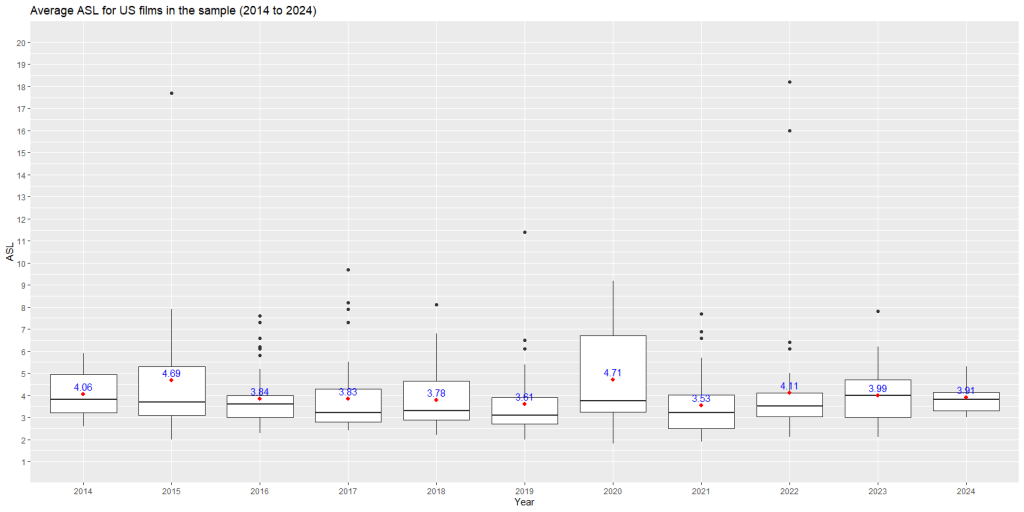
We can see this for ourselves thanks to Radomir Douglas Kokeš, who has been collecting data for a long time and publishing it on his blog. From his database, I was able to select a sample of films produced in the USA between 2014 and 2024 and calculate the variance of average shot lengths. I had 430 films and episodes in my sample. Sure, it’s not all that’s been produced, but better data just aren’t available.
The graph clearly shows that although the average shot length varies, it oscillates around similar values (average of averages).
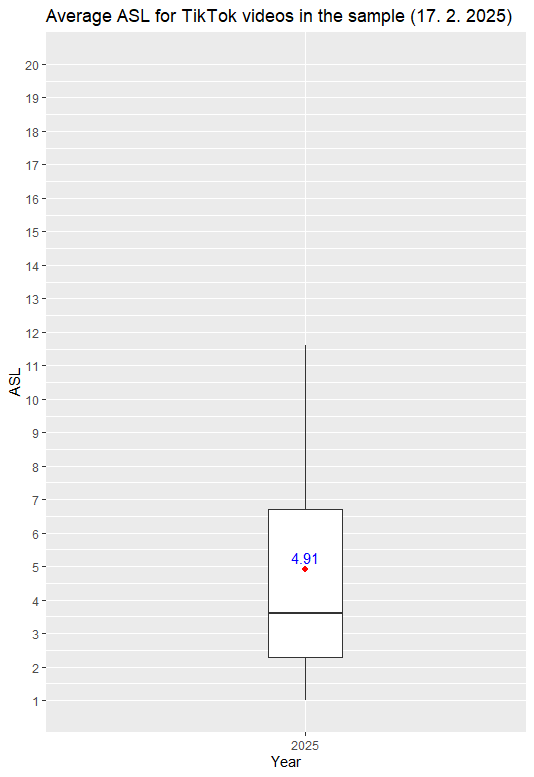
Now let’s see what the average shot length of videos on TikTok is. Admittedly, I don’t have as large a database as Douglas. I collected the data in an unsystematic way one afternoon by sitting down at my desk with TikTok on my smartphone, turning on screen recording, and recording one video from start to finish for about 25 minutes. I then uploaded the file from my phone to my computer and took the classic shot length measurements I’m used to. For each video, I noted the lentg and the number of takes, from which I got the average shot length. In total, there were 19 videos in my sample (including two commercials, two split-screen videos, and five videos that were more like slideshow photographs).
The average shot length of videos on TikTok is longer than the average shot length of American movies. While the median is similar, the boundaries for the third and fourth quartiles are shifted by seconds.
Of course, one could argue that this is due to the sample, and that if I had measured on a different day or in someone else’s recommendation algorithm, I would have gotten different numbers. Sure.
On the other hand, there are arguments that the higher average shot length for TikTok videos may not be accidental. One of the reactions of our eye movement to editing in film is to reorient our gaze to the center of the screen. Research shows that viewers of portrait format videos (which is the format on TikTok) exhibit a weaker central bias than viewers of landscape videos (the format of movies and TV shows). I don’t know what videos specifically the measurements were taken on, but the weaker central bias could indicate a smaller number of cuts after which our gaze turns to the center.
Anyway, I want to repeat the measurements in some time to make sure. For now, I’ll go with the measured data and therefore…
In terms of average shot length, TikTok is simply slower than American movies and TV shows. It is not a fundamental difference, but it is there. When you think about it, it’s not really surprising. On TikTok, many of the videos are shot in one take (I had 6 videos in one take in my sample). These videos will inevitably slow down the TikTok experience and increase the average shot length. But in a way, they are the simplest thing a creator can do and therefore the most typical.
Well, to summarize. Some viewers seem to get the impression of speed from the TikTok videos. This impression is so intense that it has made its way (in a form of intuitive claims) in to academic papers. The problem is that we don’t know how to quantify this impression. For now, the only measurable value is the short duration of the videos, but I don’t think that is relevant evidence of the impression of speed. Especially when the average shot length is higher for TikTok than for the average American film. I therefore put more hope in the amount of information (text + speech) conveyed in the videos, but I’ll leave that for another time.
It’s evening. I’m not going out, but I don’t feel like reading, so I’m watching a movie on an unnamed streaming platform. When choosing, I prefer movies I’ve already seen. Why? So I don’t feel guilty about looking at my phone every now and then.
A not insignificant number of viewers are reportedly thinking along similar lines to this scenario. They watch a film unfocused, or while doing something else. In another post I addressed casual viewing and today I want to look at the changing ways of viewing audiovisual content from the perspective of watching multiple screens simultaneously.
There are several interesting studies on the topic in which researchers have looked at the viewing practice of watching multiple screens simultaneously.
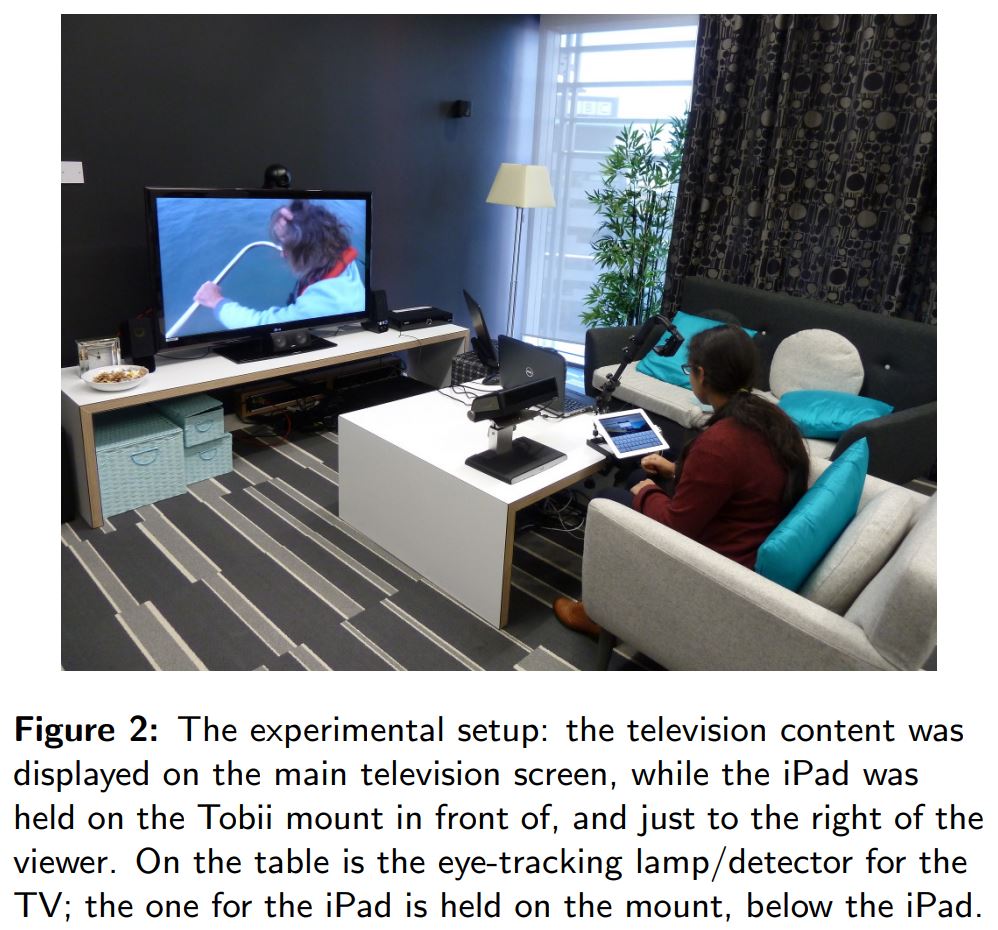
All of the studies are impressive because they experimentally test how viewers behave. They use an eye-tracker (mobile or stationary) and think about setting to resemble a living room as much as possible and a laboratory as little as possible. In other words, they make sure that the experiment reflects the natural environment.
The results are then very compelling and show that viewers are primarily watching TV and paying less attention to the tablet/phone (by a ratio of 2:1 to 5:1).
The problem is that all these experiments are formulated from start to finish in such a way that it is clearly established which screen is “first” and which is “second”. Even the choice of what is played on the second screen is only complementary to what is played on the first screen. For all three studies, this approach is understandable. Their intent was to offer data to make multi-screen viewing consistent, which could then be used by media companies to develop applications. But if we are interested in the relationship between audiovisual and spectator behaviour, we necessarily feel that something has been left out. They left aside the fact that there is a competition for our attention in the media market.
It may well be that the attention paid to movies and TikTok is different when the division between first and second screen is abolished. And it’s also quite possible that some movies are less successful at attracting attention (though studies suggest that this is not the case).
I would like to build on the three studies mentioned and think about how to implement experiments in a way that reflects the battle of the screens. To start with, users will need to break the hierarchy of the first and second screens and let them be free.
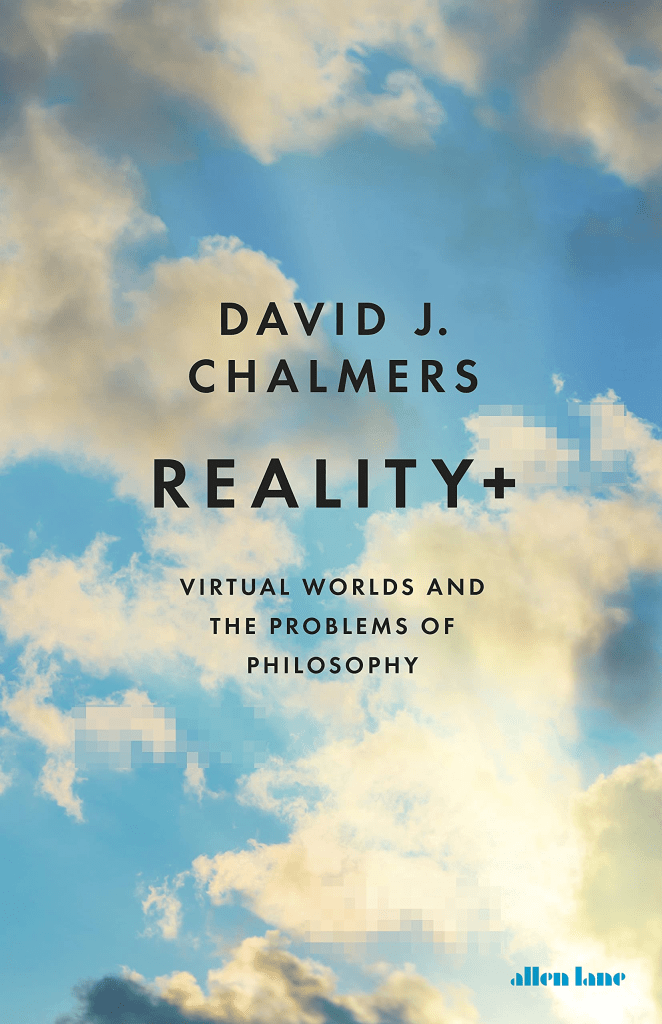
I decided to mix my reading about TikTok, social networks and cognitive psychology with a few philosophical books. In the case of Chalmers in particular, I initially felt that I might not be too far off thematically since he addressed the topic of virtual reality in his last book. Well, I was a bit mistaken. Chalmers has very different interests than I do, and he clearly tends to address problems of ontology, epistemology and ethics. In the context of TikTok, especially in the context of the current debate about whether or not to ban it, I found only one passage explicitly related. But I want to comment briefly on the rest of the book too.
First of all, it’s absolutely brilliantly written. In fact, I can well enough imagine that if this was what teaching philosophy in high schools was like, philosophy would have a very different reputation. Chalmers not only displays a deep erudition in Western philosophy, but also makes excursions into the non-Western philosophical tradition and especially into pop culture (especially science fiction literature, but also films such as The Matrix, The Thirteenth Floor, The Truman Show or series such as Star Trek: The Next Generation). Thinking about and through virtual reality (at least in the form of thought experiments) then leads him to rethink many philosophical concepts. Some of these – Plato’s Theory of Forms or the theistic conception of the world – are rather bizarre in the tradition of naturalised analytic philosophy. Chalmers approaches all of them with an open mind and is willing to grant them some persuasiveness in the context of his argument. If one of the functions of philosophy is to open minds and develop critical thinking, here it succeeds perfectly.
But now to the chapter on Value, where I find several points to consider in the case of the current discussion of TikTok. Recall that a few weeks ago it looked like TikTok was going to be banned in the US, then it didn’t even run for half a day before the new US President decided that things might be quite different. The case is summarized on wikipedia. What I found most interesting about the discussion was how the arguments for the ban were layered. We could see a diverse range of opinions covering national security, data protection, but also the dangers of TikTok for child users. I’m not competent to judge the extent to which TikTok can endanger America or damage the minds of children, and I don’t get the impression that there is a consensus on this. Let’s leave aside the legal, political and social dimension of the debate and think about whether TikTok has any value to the individual. Specifically, then, I will consider four possible values that Chalmers considers in the context of virtual reality.
In the chapter, Chalmers works with four traditional approaches to what it means that something is good for someone: hedonism, desire-satisfaction, social, and objective-list. Let’s look at what these approaches tell us about TikTok.
Second in line is desire-satisfaction, or the approach that argues that a good life is one that brings about the fulfillment of our desires. Here we do not get simple hormonal satisfaction in the brain causing addiction to TikTok, which would again be contrary to a good and worthwhile life. Desire-satisfaction is probably the most advocated approach to value, promoted by the users themselves. Certainly not all of them, but a significant portion of them. Desire-satisfaction is implicitly present in all the motivational self-help videos, investment videos and exercise videos that are on TIkTok. I can’t judge whether this approach to values is correct, but TikTok, and by extension other social networks, are the venues through which desire-satisfaction spreads. And it only spreads because it finds a response from users who are willing to spend money on manuals, consultants and coaches to help them achieve financial independence, mental stability and a beautiful body.
The social perspective argues that the value lies in connecting with other people. Although social networks are often criticized for distancing people and creating moats in society, they are undoubtedly a tool that allows each of us to be in touch with family and friends at almost any time. For example, I can stop typing now and ask my wife Kristýna how many of her friends she has communicated with on social media today. The question is whether TikTok, which is primarily for sharing videos, offers social value. Here, though, it may just be a generational issue. While I wouldn’t be able to use videos to communicate operationally because I would be thinking through the angle, composition, and exact script of what I’m saying, some of my students already talk about making videos online as something natural. So at the very least, I don’t want to deny TikTok a social dimension. On the other hand social interaction is via TikTok and not with TikTok. Interaction with app and deep scrolling are understood as destructive practices.
And finally, the objective-list, which is the most subjective of all approaches. Even if we agree that the values are knowledge, friendship, and fulfillment (as Chalmers writes), we can never agree on whether TikTok helps us towards or away from those values. Whether TikTok serves an educational function is disputed (are student questionnaires a relevant method when we consider, that they may be already addicted to TikTok?), and whether the friendships on TikTok are real is also hard to agree on. I, for one, may be convinced that TikTok does not belong in the hands of children, but that does not mean that contact with TikTok will automatically damage their brains. In doing so, I feel that the current discussion about banning TikTok is being conducted on a moral level through the most vague objective-list approach to values.
In conclusion, let me just summarize that from an individual perspective, TikTok does not strike me as a fundamentally immoral application. Of course it has risks, of course its use can be dangerous for certain groups, but we could probably say that about all social networks or tools in general (guns, cars, staircases). I hope the political and social arguments of the proponents of banning TikTok are more convincing.
And if we look away from TikTok and look at short videos in general, their value is no less than that of other forms of audiovisual (information, advertising, communication, entertainment, or even art…). The problem is obviously in the platforms and may remind us of the critical perception of Hollywood. But this means that banning one platform won’t solve anything, because people will find another, as happened with the migration of Americans to Red Note.
This week and next week I will be attending an AI-focused bootcamp. Thanks to Farshad Einabadi, who is the tutor, it is an incredible experience. One of the most beneficial events in a long time.
I don’t want to go into details because I don’t understand the AI issues. The course is aimed at beginners and includes programming in Python. In this way, Farshad is showing us how AI works and how we can use AI to create.
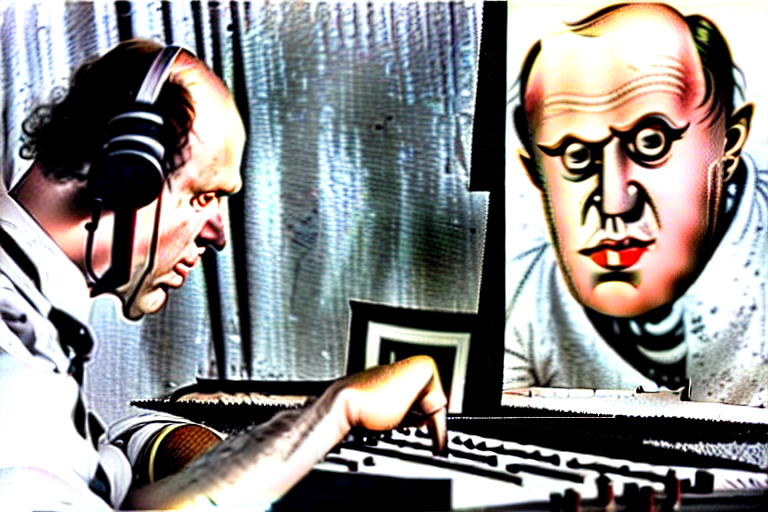
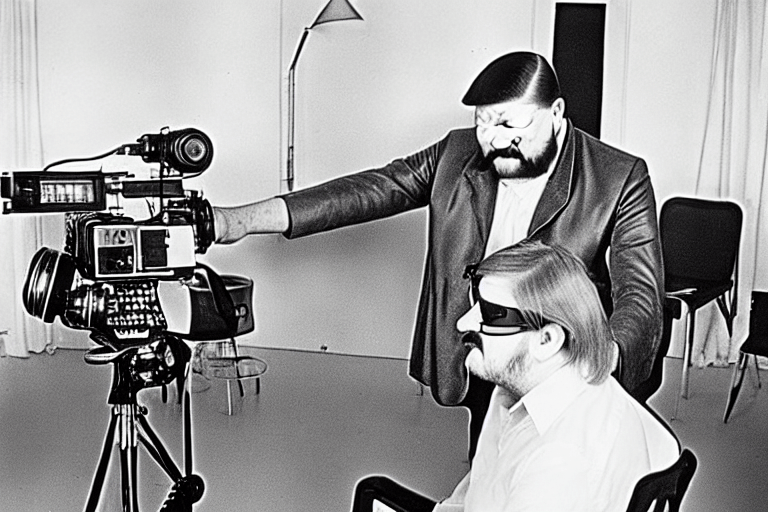
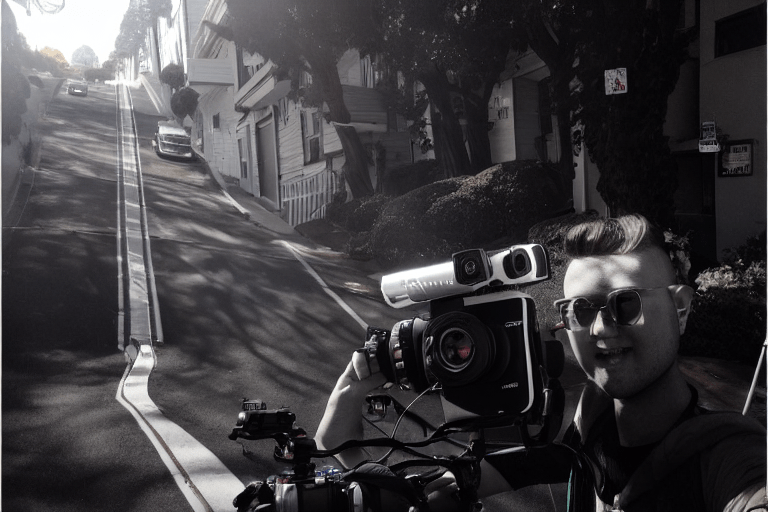
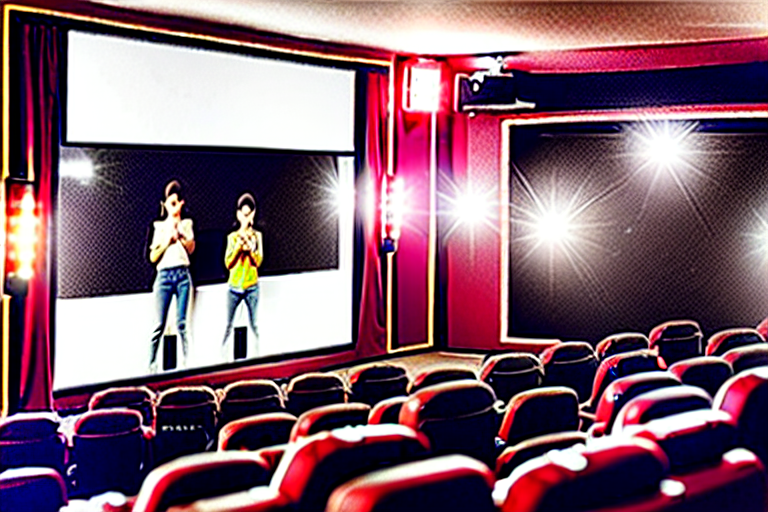
The first part of the course was about Stable Diffusion and image generation. Below you can see examples of the four images I generated. These are edits of my favorite photos (+ 1 drawing) from the history of cinema. I had them edited to depict a world where films were replaced by TikTok a long time ago.
Soviet filmmaker Sergei Eisenstein edits his latest TikTok video.
Rainer Werner Fassbinder shoots his new TikTok video.
A camera ride during the filming of the TikTok version of Diamonds of the Night (1964).
And finally, a slightly depressing shot of an empty cinema and two characters watching a mobile phone on screen.
When I first installed TikTok a few years ago, I thought to myself that this is something people must have experienced in the early 20th century with film. A new form of audio-visual entertainment that resembles its predecessors, but with slightly different possibilities. Creators have tried to work with the medium with varying degrees of success. The audience succumbs to its charms. Intellectuals are confused.
Like any historical analogy, of course, this one is inaccurate, but I want to use it to illustrate a research desire that I thought I would have no luck fulfilling. I ask the reader, then, to understand this analogy of TikTok and early cinema more as an evocation of my feelings about the subject of research. It reminded me of something I experienced 16 years ago.
When I was a film studies student reading the antology of new film history (Nová filmová historie: antologie současného myšlení o dějinách kinematografie a audiovizuální kultury. 2004), I was fascinated by the texts of Thomas Elsaesser, Tom Gunning, and Charles Musser on early cinema. These were translations of older texts into Czech.
I was fascinated by Thomas Elsaesser’s texts because of the way they managed to overturn my perception of the past. Suddenly, I didn’t understand the films of Lumiere and Porter through the eyes of a film studies student in 2009, but I realised that it was necessary to accept the period context and try to understand the films within it. These were not films at the beginning of cinema history. On the contrary, they were the result of history. From a research point of view, this meant studying literature and archival sources, which accompanied me for the rest of my studies. It was only later that I realised that I didn’t have to try to reconstruct the contexts of the past, and that’s how I got into current audiovisual culture.
I have always enjoyed reading Tom Gunning’s texts for their myth-busting power. Specifically with the text ‘An Aesthetic of Astonishment: Early Film and the (In)credulous Spectator’ (Art And Text 34, Spring 1989 and many other times), it still fascinates me how he has managed to break out of the decades-old notion of naive spectators. The paradox is that the idea of naivety is still firmly rooted in us, which makes us naive ourselves. Otherwise, we could not think that short videos on the internet are “killing” or “eating” the brains of our children.
I like Charles Musser’s text ‘The Nickelodeon Era Begins: Establishing the Framework for Hollywood’s Mode of Representation’ (in Early Cinema. Space, Frame, Narrative, ed. T. Elsaesser. 1990) today more out of nostalgia. In terms of the formulation of the research problem and the arguments, I view it very critically today, but I used to give it to students to read despite the difficulties. Its greatest strength, I believe, is in its ability to convey an almost romantic image of film projection in the early era of cinema. However, Musser doesn’t simplify the situation, but instead points out the little details that show the complexity of the early years of film. One of the things that Musser has been focusing on is the composition of programs from different types of film and non-film performances. My colleague Chris Hogg talked about TikTok in a similar way when we spoke in the fall.
After reading these texts, I have always been a little sad that I will never experience the early era of cinema again. It’s not that the present is qualitatively different in terms of new film history. It was that early cinema was shown in the aforementioned texts as a stage of creative phase, where filmmakers explored a new medium, audiences were getting used to it, and together, from the bottom up, cinema was being made. Today, of course, it is similar with films and TV series. I just kind of get the impression that we all know what we’re doing (though maybe that’s what Porter thought, too).
TikTok changed that. Suddenly I saw a platform where people with no prior filmmaking or artistic training were staging funny sketches. I saw a platform where different types of performances alternated from trivia and commentary to musical performances to self-help videos. I immediately realized that this must have been how our ancestors must have felt in the early 20th century when they came to nickelodeon. They understood something, they didn’t understand something else, but they were actually having fun. It wasn’t artistic entertainment, but everyone was fascinated. Just like TikTok today.