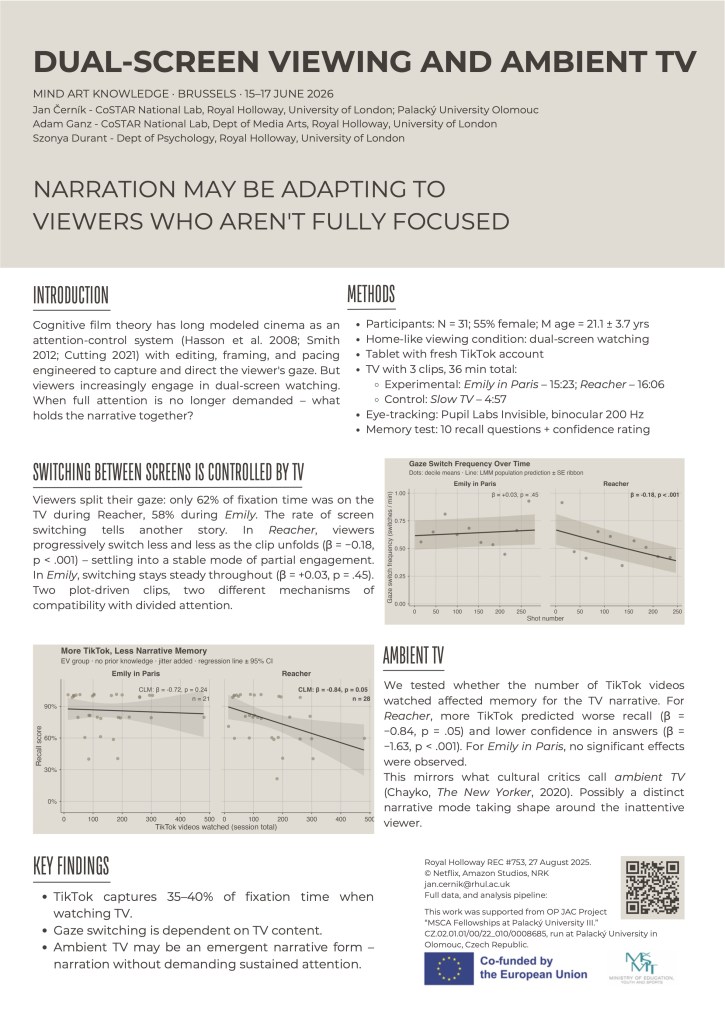
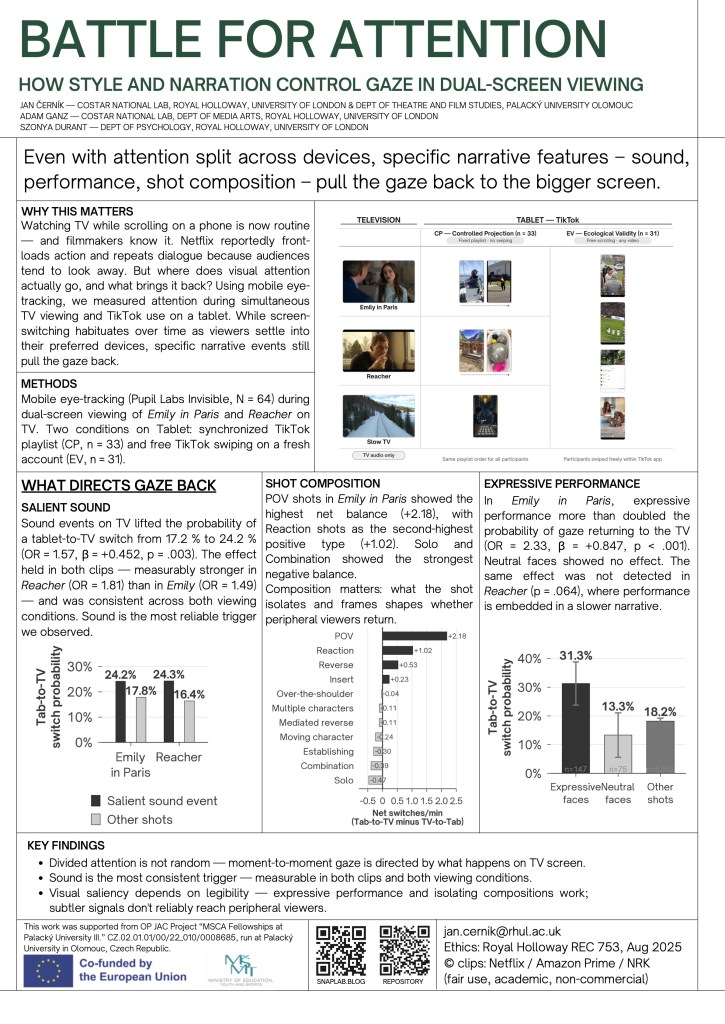
Recently, I had the opportunity to attend the Mind Art Knowledge conference, where I presented our latest research on dual-screen watching.
The core focus of our poster is the emergence of “ambient TV.” Until now, ambient TV has mostly been treated as a neat concept in cultural journalism. In our poster, we proposed a concrete, empirical way to actually test this phenomenon.
Because we presented it in a poster format, we intentionally leaned into the medium to make it a bit of a provocation…
Yesterday, I was lucky to visit the Creative Computing Institute (CCI), and specifically Tim Smith‘s team, at the University of the Arts London. Tim invited me to give a short presentation about the research I am conducting at Royal Holloway under the supervision of Adam Ganz and Szonya Durant. Besides that, Tim showed me their facilities, and we had a talk about computer vision in cinema research.
In my talk, I presented a selection of the most interesting findings from the last 18 months: a) the difference between watching videos in vertical and horizontal frames, b) a null result regarding the effect of screen time on gaze patterns (both soon to be published in Projections), c) how people simultaneously watch narrative stimuli on TV and TikTok on a tablet (article just before submission), and d) which formal elements of narrative stimuli pull visual attention from a tablet to a TV screen (what I am working on). My main argument was that, contrary to my initial assumption, TikTok (and short video platforms in general) is probably not changing how we watch films. Rather, short videos (among other things) have made us aware of the audience’s inattentiveness. However, the fact that people are distracted is not new and it was always like that. It is just more visible now.
On a personal level, it was amazing to see the Creative Computing Institute and how Tim approaches research in the arts and humanities. I know very well from CoSTAR that arts research can look very different from what I was trained in. The CCI combines research activities with teaching, and it is inherently interdisciplinary. Truly, one can hardly say where one discipline ends and another begins. An illustrative example was when Tim showed me how they connected a virtual production studio with fNIRS and used it in a dance performance. The dancer’s brain activity produced a visualization on the LED panels behind him. This single example clearly shows how art can merge with neuroscience, technology, and programming, proving that these disciplines are not only communicating but also mutually beneficial.
Have you heard about it? A goldfish has longer attention span than people! Our ability to focus has shrunk because of watching short videos. Besides other things it means that you will read only the first paragraph of my blog. So you won’t learn that the whole attention span crisis is nonsense and that our research article was accepted by Projections journal.
After several years of reading about the attention span crisis, I noticed an opposite trend this year. In March there was an article in the Financial Times disputing the shrinkage of our attention span. The author is even citing Gloria Mark:
The psychologist Gloria Mark, who is often quoted in relation to our degrading attention spans — and some of whose research landed us at this median number [47 seconds] — said on a podcast last year: “I don’t believe that our basic ability to pay attention has changed.”
For those of you who don’t know Gloria Mark’s name – her research is probably the reason why we thought there was a reason to believe that something is happening to our attention. However Gloria Mark was measuring how long it takes to switch between screens on your laptop when you are working. It is not really about attention, is it? I mean we could easily assume that when working on a Mac people would be switching more, because it is easier than on a PC. But it wouldn’t automatically mean that there is a causality between having a Mac and worse attention.
But even so, you might feel that your attention is worse than it was and that today’s kids’ attention is worse than that of kids decades ago. And exactly this feeling is the main reason we are talking about the attention crisis in the first place. According to article from Nature, no published data suggest something is happening to our ability to focus when we are not distracted. However, as the article stresses, the distractions are not always bad.
And distraction itself is not always the enemy. An important finding from controlled lab studies of attention is that even when volunteers have no external distractions, their minds still wander, often without conscious awareness that they have gone off task.
Esterman, who has spent years studying these fluctuations, argues that the flickering of attention must originate in the brain as useful internal processes that can distract us, including thoughts, ruminations and worries. Periods of mind-wandering can support creativity, planning and problem-solving, enabling the brain to explore and integrate ideas.
Now you might feel a little bit calmer about your attention. However, years of misinterpretations have brought us to a point where governments of Western countries are considering bans on social media for kids and bans on smartphones in schools. The technology is once again seen as the root of evil. This was the main topic of an online roundtable “Born Digital: Social Media, Screen‑Time, and the UK’s Public Consultation” organised by William Proctor. The discussion wasn’t about attention. It was rather about – according to panelists – baseless legislation, driven by moral panic about the new technology and scaremongering about the impact on children.
These three examples of course aren’t the first to raise doubts about our shrinking attention span and bad influence of technology. Today I bought a book Unlocked: The Real Science of Screen Time (and how to spend it better) written by psychologist Pete Etchells which is supposed to be sceptical about the bad influence of screens in 2024.
In this context I am happy to announce that this week an article I co-authored with Szonya Durant and Adam Ganz was accepted by the journal Projections. One part of the article discusses the null results from a correlation analysis we conducted. Among other things, we were interested in whether there is any relation between screen time on short video platforms (ranging between 0 and 4 hours a day) and four gaze metrics (fixation duration, length of horizontal saccades, proportion of vertical saccades, fixation entropy). And we found none. Despite a small number of participants and therefore being underpowered for small effects, I am really glad that publication of null results regarding screen time was supported by reviewers and editors of the journal.
After six months of work on this project, I finally have my first set of data. In this post, I want to reflect on what these data might tell us about people’s relationship with TikTok—and what they reveal about how we study the perception of this platform. It’s not just about what the data show, but also how we interpret them and what questions we should be asking next.
In my initial experiment, I collected valid data from 28 participants. Each participant watched the same set of videos on a computer with eye-tracker, presented in two formats: landscape and portrait. Before every session I made a note of participants’ screen time (TikTok, Instagram, and YouTube) – not through self-reporting, but by directly checking the screen time data on their phones.
After processing and analysing the data, we obtained interesting information about differences in fixation entropy, saccade directions, and, in general, the relationship between video format and stylistic elements in the context of perception. We are preparing academic outputs on all of this. But what surprised me the most was something else.
We were unable to measure any convincing effect of screen time on the way videos are watched. It even makes me rethink some of my hypotheses. But let’s take it step by step.
To be honest, I did find one statistically significant correlation. And it’s one that deserves a headline in the newspapers: TikTok makes you less focused when watching movies!
Sounds serious, right?
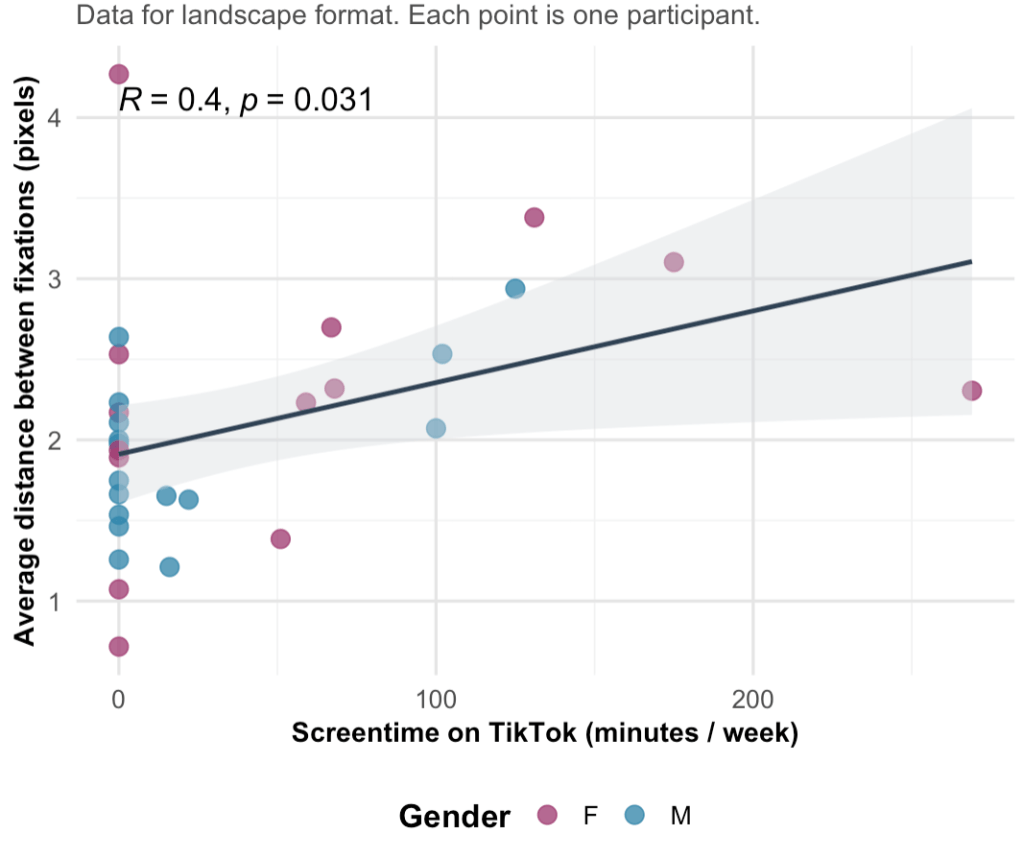
More precisely, we found that participants with higher average screen time on TikTok have a greater distance between fixations when watching landscape videos. In other words, if you watch a lot of TikTok and then watch a movie, your eyes will jump around more than the eyes of people who don’t watch TikTok.
Does it still sound serious?
Take a look at the graph illustrating this effect. The p-value even shows that the effect is statistically significant.
Does it sound even more serious now?
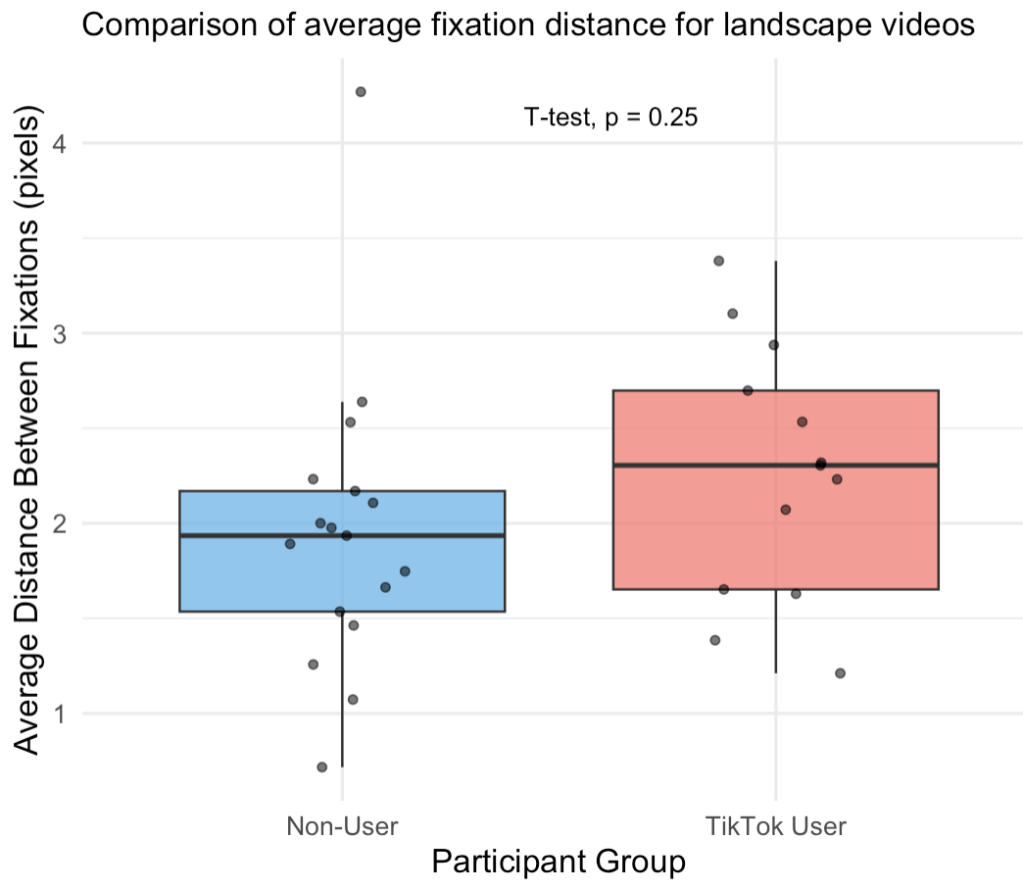
Notice the dots on the y-axis that have zero screen time on TikTok. Let’s try visualizing the data differently to get two groups: TikTok users and non-users.
And suddenly, the effect is gone. Or at least it is so small and statistically insignificant that nothing can be said with certainty on its basis.
What happened?
Imagine that you collect a huge amount of data (fixations, saccades, pupil diameters, blinking… in the spreadsheet with more than 100 columns and calculate metrics such as entropy, dispersion…) and add to it other data from a questionnaire (age, gender, average screen time…). Then you just try to look for what correlates with what until you find that some correlation is statistically significant. In other words, you are committing fraud by randomly comparing data and looking for something that looks like positive result. And when you get a low p-value, only then do you formulate a hypothesis. This is called data fishing or p-hacking.
I was in the opposite situation. I measured the effect predicted by the hypothesis. The problem was that when I then explored other variants of correlations between screen time and eye-tracker data, I didn’t find any other statistically significant correlations. The one with screen time on TikTok and fixation distance in landscape videos was the only one. Sometimes it even showed me that higher screen time correlates with more focused fixations. The complete opposite.
These findings have led me to reconsider some of my initial assumptions. I originally believed that long-term exposure to TikTok would affect the way we watch films. But based on the current data, that effect is either not present or not captured by my experimental design. In any case, I don’t have sufficient evidence to claim that screen time directly influences how we watch videos. What’s more, I began to doubt whether it still makes sense to continue focusing on studying influence of screen time on viewing habits.
Another important takeaway concerns how we interpret claims about TikTok’s influence on cognition. Keeping in mind what Stuart Ritchie wrote in his excellent book Science Fictions, I’ve begun to question the many articles that describe TikTok as fundamentally reshaping our brains and behavior. Perhaps those effects are real—but we should be cautious when such strong claims are supported by just a single metric from an eye tracker or similarly narrow data sources.
Finally, these results also shape how I’ll present my own research moving forward. I’ll keep the question in the title of this post, because it’s accessible and engaging. But in answering it, I’ll emphasise a crucial distinction between a) TikTok as an app, b) the formal elements typical of TikTok videos, and c) the vertical video format itself. Unlike screen time, both the formal elements and the vertical format show clear evidence of influencing how we watch
I often encounter the opinion that TikTok is fast. Frankly, I’ve never understood it. I could describe TikTok in a number of words, but speed would not be one of them. Maybe the problem is what we mean by speed.
“the videos’ short length creates an accelerated, hypnotic pace of viewing. The videos are themselves often accelerated and/or stuttering, edited to a speed that puts chaos cinema in the rearview mirror and further normalizes jump cuts as the rule for online videos”
I identify speed in three senses in the quote:
the fast pace caused by the short length of the videos
the acceleration of videos
the use of jump-cuts to eliminate shots where nothing important is happening
In at least two of these, it is something we have known for decades, so it hardly surprises any viewers today. Anyone who has ever watched a silent movie has encountered video acceleration (the reason for this is the different standard of projection speed expressed in terms of the number of frames of film stock per second of projection).
Similarly, the jump-cut cannot be considered anything groundbreaking. It is associated in film history books with Godard’s A bout de souffle (1960), but even that was not the first use. David Bordwell wrote an article on the jump-cut in 1984 (Wide Angle, vol. 6, no. 1) where he points out that the jump-cut had been used since the early era. In my notes, I found uses of the jump-cut in, for example, the Finnish film Valkoinen peura (1952, Erik Blomberg).
The remarkable speed of TikTok can therefore perhaps only be explained by the short length of the videos. And while we could find examples from the past (commercial breaks on TV, blocks of trailers and ads in cinemas before the screening starts, blocks of video clips on TV and YouTube), TikTok has at least contributed to shortening videos to a new level.
But the list of possible understandings of what makes TiKTok fast is not, in my opinion, complete. Leaving aside the contextual aspects of video production speed and TikTok’s speed of expansion. The impression of TikTok’s speed could still be caused by at least two things: 1. the average shot length of a TikTok video, 2. the amount of information conveyed through spoken word or text. Given complexity of the combination of spoken word, text in videos, text in subtitles, and text in the app interface, I’ll leave point 2 for another time. In the following lines, I will focus on the average length of a shot.
Average shot length is, in my opinion, a better indicator of speed than simply video length. Try to imagine a hypothetical social network where users could upload 30 second long videos, but only in one take. I dare to doubt that we would consider such a social network fast in any sense. We might even find it slow and boring. Especially compared to the US film and series, where the average shot length is between 3 and 5 seconds.
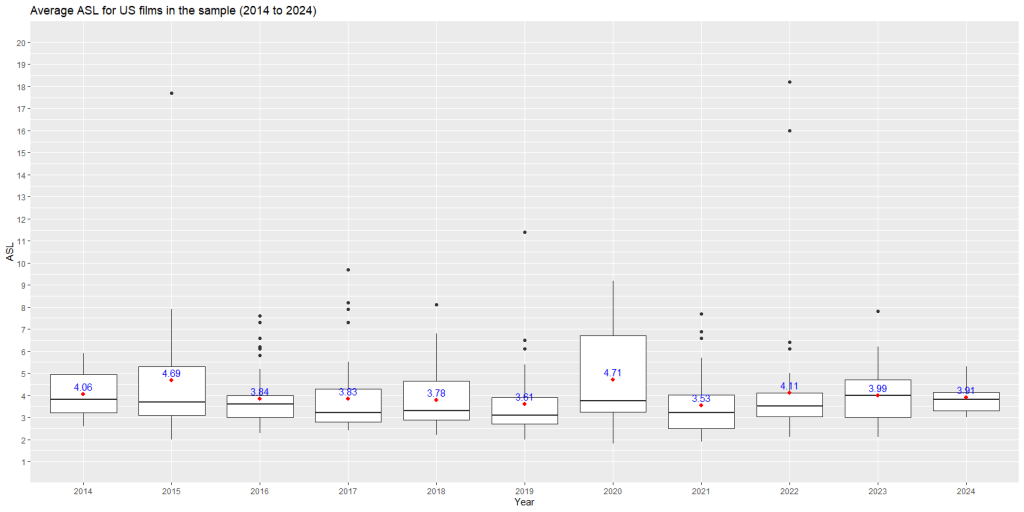
We can see this for ourselves thanks to Radomir Douglas Kokeš, who has been collecting data for a long time and publishing it on his blog. From his database, I was able to select a sample of films produced in the USA between 2014 and 2024 and calculate the variance of average shot lengths. I had 430 films and episodes in my sample. Sure, it’s not all that’s been produced, but better data just aren’t available.
The graph clearly shows that although the average shot length varies, it oscillates around similar values (average of averages).
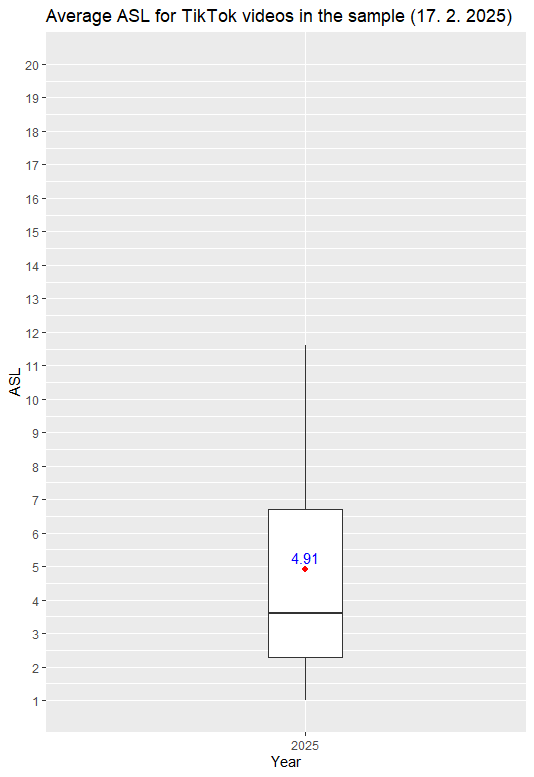
Now let’s see what the average shot length of videos on TikTok is. Admittedly, I don’t have as large a database as Douglas. I collected the data in an unsystematic way one afternoon by sitting down at my desk with TikTok on my smartphone, turning on screen recording, and recording one video from start to finish for about 25 minutes. I then uploaded the file from my phone to my computer and took the classic shot length measurements I’m used to. For each video, I noted the lentg and the number of takes, from which I got the average shot length. In total, there were 19 videos in my sample (including two commercials, two split-screen videos, and five videos that were more like slideshow photographs).
The average shot length of videos on TikTok is longer than the average shot length of American movies. While the median is similar, the boundaries for the third and fourth quartiles are shifted by seconds.
Of course, one could argue that this is due to the sample, and that if I had measured on a different day or in someone else’s recommendation algorithm, I would have gotten different numbers. Sure.
On the other hand, there are arguments that the higher average shot length for TikTok videos may not be accidental. One of the reactions of our eye movement to editing in film is to reorient our gaze to the center of the screen. Research shows that viewers of portrait format videos (which is the format on TikTok) exhibit a weaker central bias than viewers of landscape videos (the format of movies and TV shows). I don’t know what videos specifically the measurements were taken on, but the weaker central bias could indicate a smaller number of cuts after which our gaze turns to the center.
Anyway, I want to repeat the measurements in some time to make sure. For now, I’ll go with the measured data and therefore…
In terms of average shot length, TikTok is simply slower than American movies and TV shows. It is not a fundamental difference, but it is there. When you think about it, it’s not really surprising. On TikTok, many of the videos are shot in one take (I had 6 videos in one take in my sample). These videos will inevitably slow down the TikTok experience and increase the average shot length. But in a way, they are the simplest thing a creator can do and therefore the most typical.
Well, to summarize. Some viewers seem to get the impression of speed from the TikTok videos. This impression is so intense that it has made its way (in a form of intuitive claims) in to academic papers. The problem is that we don’t know how to quantify this impression. For now, the only measurable value is the short duration of the videos, but I don’t think that is relevant evidence of the impression of speed. Especially when the average shot length is higher for TikTok than for the average American film. I therefore put more hope in the amount of information (text + speech) conveyed in the videos, but I’ll leave that for another time.