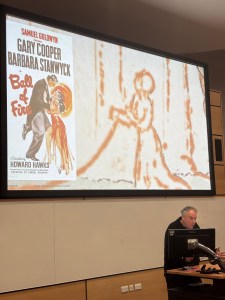
My dear supervisor recently gave his inaugural lecture. Over the past year, I have mainly discussed my research ideas with him, so it was great to hear what he himself has been thinking about. He guided us through his reflections on storytelling that arises from the place where it takes place. He started with William Blake and, via ancient myths, Hollywood films, and his own work, arrived at AI.
I’m looking forward to seeing Professor Adam Ganz’s latest film, Synthetic Sincerity.
The second day of the conference had one clear highlight for me—Ola Røyseland‘s presentation. His contribution was called Frame/less, and I was surprised by how close his thoughts were to mine. Ola is a filmmaker who focuses on shooting short films in his doctoral thesis. He draws on two assumptions: 1. we watch films because they convey emotions to us through narration, 2. VR is associated with a lack of emotion and weak narration. His goal is to identify which formal techniques are suitable for storytelling in VR. To achieve this, he shoots each of his films in two different formats—classic film and 180 degrees. He then tests his films on audiences to find out what works and what doesn’t.
Olovy’s films are short, entertaining, and experiment with things such as narrative perspective and point of view.
I was thrilled by Ola’s presentation. He demonstrated exactly the kind of thinking that interests me in filmmakers and managed to formulate it as a research problem that he addresses in his work. I sincerely hope that this was not my last encounter with Ola.
I was also intrigued by Lukáš Hejtmánek‘s presentation on multisensory perception. Although it is relatively distant from my topic, I enjoyed the playfulness with which they carried out their experiment. In short, it was about verifying what sensory stimuli need to be simulated in order for a visit to the forest in VR to have a therapeutic effect. Surprisingly, artificial grass underfoot and aroma lamps are not necessary. Apparently, visual and auditory stimuli are enough.
The next day, I also realized that another great contributions by Oliver Kobián and Pavel Srp (yesterday) had something in common: both studied under Lukáš Hejtmánek.
I also found Marika Hedemyr‘s contribution extremely inspiring. She talked about her mixed reality project. At one point, she emphasized the importance of pauses in directing the attention of people participating in her project. She deliberately placed pauses after significant sentences in the audio guide’s speech (e.g., questions). She determined the length of the pauses intuitively, but not at first glance, and from what she showed us, the pauses lasted from a few to tens of seconds.
And that was the ZIP-Scene Conference for me. I don’t know if the organizers will want to invite me back next year, but I will definitely want to come.
Today and tomorrow, I am attending the ZIP-SCENE Conference in Prague. The conference is part of the Art*VR Festival at the DOX Center for Contemporary Art.
When I saw the program, I was surprised that my proposal was accepted at all. Most of the presentations are about VR, XR, video games, etc. So my 2D vertical videos stand out a bit. I tried to choose a framing that placed the viewing of vertical videos in the context of the audiovisual landscape, which also includes VR. Some colleagues certainly noticed this, but they were kind enough to keep their doubts about compatibility to themselves.
On the contrary, I received positive feedback, and the main finding that vertical framing causes fragmented viewing surprised several colleagues. (I would like to write more here, but only after we publish it in an article we are preparing with Szonya Durant and Adam Ganz).
Nevertheless, from the other contributions, I had the impression that I had found a similarly minded audience. The ZIP-SCENE Conference is a great achievement by Ágnes Karolina Bakk‘s team. This is already the seventh year, and they have succeeded in bringing together artists and researchers from various fields who think not only about what they create, but also about how it affects the audience.
I was most interested in the following presentations:
Niels Erik Raursø presented the research activities of the Augmented Performance Lab at Aalborg University in Denmark. They are investigating how to use EEG to analyze audience responses to storytelling. In theory, this could lead to greater personalization of storytelling for the needs of individual viewers in the future. I would probably need to hear more about their research, because in this 15-minute presentation I identified some methodological problems. For example, I think they could easily fall into the trap of choosing the wrong way to segment the narrative. In any case, I found Niels’ research extremely inspiring.
Another thought-provoking presentation was by Felix Carter, Iain Glichrist, and Danae Stanton-Frasert. They experimentally explored how a change in the narrative affects the audience’s attention towards exogenous cues. In my opinion, their research potentially shows how big a difference there can be in how we understand films. Not that we encounter different editing of films in cinemas (although that is also possible). I am referring to the simple fact that not all of us pay full attention to films throughout their duration. We look at our mobile phones while watching a film, we go to the fridge or the toilet, we talk to people around us, and films on TV are interrupted by commercials.
The last contribution I want to mention from today’s program was presented by Pavel Srp. He talked about an experiment in which they tested whether a linear or logarithmic function is more suitable for determining the distance of a sound source in relation to volume. The conclusion was that a logarithmic function is more suitable. Pavel’s paper is the third I have heard at the conference in a short time from “sound people,” and all three were excellent and provided great insight into audience perception.
And since I was at the Art*VR festival, I wanted to try out what it’s like to be in virtual reality. In short, after five minutes I felt sick and it took me about an hour to recover. But tomorrow I’ll give VR another chance.
The last day of the conference had two highlights for me.
The first highlight was a reading from Deborah Klika’s screenplay Czech in the Rear View Mirror. I have known Deborah since 2023 and I know that she is proud of her Czech roots. Her screenplay is the story of her parents, who emigrated to Australia. The table read of the script was a great experience, partly because it was funny, but mainly because Deborah found Czechs living in Adelaide to play the two main characters. In addition, two other ladies from the Czech club in Adelaide came to the reading. After the reading, I had the opportunity to talk to them and it was nice to hear their stories, in varying degrees of Czech language recall.
The second highlight of the day was a presentation by Alicia Butterworth. Alicia is a sound designer and she talked about how they developed and created the VR experience We Were Children Once about Holocaust survivors. I consider it the best paper of the entire conference. Alicia was able to introduce us to the details of a sound designer’s work in preparing VR and concluded her talk with a set of recommendations for VR creators. Among the recommendations were the following regarding directing the audience’s attention in 360 degrees:
– Involve sound from pre-prod – we can help direct attention.
– VR is overwhelming for the audience – attention cues need to be significantly more obvious (louder/more present) to affect the audience than in traditional disciplines.
Sound designers therefore think about attention quite consciously. This reminded me of James Cutting’s observation that filmmakers are great psychologists. This is probably even more true of sound designers. There were two contributions from sound designers at the conference, and both showed that they think about audiences quite differently from screenwriters. From screenwriters at the conference, I heard mainly reflections on the diversity of audiences and the impossibility of generalizing about them. Sound designers approach this from the opposite angle—from perception—and thus have a quite different idea of audiences based on shared sensory experience.
That’s all from this year’s conference, and see you next time in Oxford!
Another conference day in Adelaide. This time, I decided to skip one panel to get into town. I had planned my visit to Australia—my first—very short, and I was sorry to spend it only in conference halls. I walked through part of the city center and took a short stroll through the park and botanical gardens.
In the morning, I attended a panel discussion on the role of sound in writing. The panel focused mainly on teaching methods, and Elisabeth Monge, Anne Regine Klovholt, and Ben Slater talked about how sound and recordings are used in teaching screenwriting students. I liked how Elisabeth and Anne Regine showed us how they guide students in thinking about sounds. Storytelling and interpretation are preceded by simply labelling the sounds we hear. On the other hand, when working with sounds in text, they believe that it makes no sense to just describe the sounds, but rather to explain their function. I think this demonstrated the importance of sound and how authors think about it in detail and need to have more control over it than over visuals.
In the next panel, I was intrigued by Sylvie Jane Husebye’s research project. The whole time, I kept thinking that her approach reminded me of Warren Buckland. Then I learned that she is Warren’s student. Sylvie analyzes narratives, focusing on gaps in the plot. She works on the assumption that gaps in the narrative can be quantified and that storytelling patterns can be traced based on the changing number of gaps. According to her, this could help screenwriters when thinking about their narratives. It looks like a massive project that works with a lot of empirical data, which I like.
Between panels, I had the opportunity to talk to Steven Maras about film viewing. We probably don’t agree on a lot of thinks, but we gradually came to the conclusion that the models of viewers, as theorists conceive them, are often very idealistic (Steve would say “mentalist”). In my opinion, the way to remedy this is through cognitive and empirical research. Steven sees it quite the opposite and blames David Bordwell and the cognitive tradition for how schematically theorists think about audiences.
I wonder what the results of a survey among screenwriters, directors, producers, sound designers, film theorists, archivists, and projectionists would be if they were asked to describe how they think about audiences…
Second day in Adelaide. I skipped the morning panel and prepared for my presentation.
Despite careful preparation, it didn’t work out for me this time. I talked about my postdoctoral research. I briefly described the experiment we did and tried to show how some elements of working with the audience’s attention, which can already be found in the scripts, even though they work in landscape format, change their effectiveness in directing attention when cropped to portrait format. Sometimes they are lost and sometimes they gain strength. In my opinion, depth of field was a stylistic device that, based on a qualitative comparison of data visualizations from the eye tracker, seemed to me to be more effective in maintaining attention when it was in portrait format. I will try to rework the lecture into an article and express it in a different way.
Karreen Ely-Harper immediately responded to my presentation with a comment. She first questioned eye tracking and emphasized the diversity of the viewing experience. I encountered a similar opinion later in the foyer. Strange. I didn’t really understand what bothered them. When I had the opportunity to talk to Karreen again later, I found that we agreed on many things. We both think that the vertical format requires a different approach from filmmakers, and we both agree that it requires a different approach to writing—more focused on space and position in the frame. And we both suspect that TikTok could influence how people think about narrative segmentation. We may disagree on the details, but I was glad that we found common ground for discussion and perhaps even future collaboration.
The discussion with Karreen was very enriching for me. She came up with the claim that it makes no sense for young filmmakers to strive to make a short film. It is much easier and more effective for their careers to make a micro-drama or a short video for TikTok. It’s cheap, fast, and it doesn’t hurt so much when mistakes are made.
What else did I see at the conference?
I was on the panel with Brett Davies, who talked about Steven Spielberg’s television work. Yes, that’s how compatible our papers were. Apparently, the other speakers dropped out of Brett’s and my panel, so we were left on our own. But I didn’t mind. Brett talked about Spielberg’s series Amazing Stories, which I hadn’t had a chance to see and which made me quite curious.
I also attended a panel on feminism and comedy-drama, featuring Deborah Klika, Susan Cake, Marilyn Leder, and Joanne Tindale. All of them are screenwriters who aspire to reflect their approach to their work. It was interesting to see the role theory has in their work. This was most evident in Joanne’s case. She took theoretical knowledge about the representation of aging women in films and used it to formulate principles that she herself wants to adhere to when writing characters. I don’t know if it will work, but in any case, that’s what I enjoy about the SRN conference—seeing how filmmakers think.
At the end of the day, I attended a screening of Elenydd (2025, Richard O’Sullivan). Before the screening, the author gave a lecture explaining his concept. I am probably too simple-minded to fully understand the continental philosophy of embodied ways of seeing the landscape. But something else caught my attention in the film itself. Most of it consisted of quite nice extreme long shots/establishing shots of the Welsh landscape. However, I noticed that in some shots I had the impression that I didn’t know where to look. It’s hard to say if that was Richard’s intention, but sometimes the shot seemed to lack a salient element. Most of the shots had it approximately in the center of the composition. But a few shots lacked such an element. It would be interesting to test whether others struggle to identify the salient element in the same shots as I do.
As is now tradition, I am participating in the Screenwriting Research Network in September. This time in Adelaide at the University of South Australia. Although I am gradually moving away from screenwriting as a research topic, I enjoy attending this event. Every year, I enjoy the exchange of experiences between academics and screenwriters and the reflections of screenwriting teachers on the education of new writers.
For me, the beginning of the conference is marked mainly by a twenty-hour flight. Not that it’s wasted time, but I’m just exhausted. On the plane, I managed to watch the film El Ankaboot (2022, Ahmad Nader Galal). I was thinking about watching something else, but in the end I couldn’t resist and went for the selection of Arabic films. Two things in particular caught my attention in the film:
1. Everywhere, the premise of the film is advertised as follows:
An action thriller that revolves around a dangerous drug dealer, who is able to manufacture new drugs and sells them but falls into many problems and is chased by the police.
Either I didn’t understand the film, or this is the synopsis for a different film.
2. Almost every time female characters appeared in a scene, it felt like the genre was changing (conversational comedy, romantic film, relationship drama…).
In addition, there were several narratively interesting moments when the perspectives of several characters intertwined. Also, I felt that I sometimes got lost in the dialogues because I missed some cultural specifics.
Anyway, I really enjoyed it.
Today’s conference program had only one item on the agenda: a discussion with local film director and screenwriter Sophie Hyde, whose film Jimpa premiered at Sundance this year. Most of the debate focused on her writing process, which is understandable given the event. But I was intrigued when she talked about how difficult it is for Australians to break into the American market. I would never have thought so, considering all the Australian actors and musicians. But then Rosanne Welch, an American and chair of the Screenwriting Research Network, confirmed this to me in the foyer.
Anyway, I’m going to bed because I have my paper tomorrow.
On Thursday, May 15, 2025, we welcomed Tim Smith from the University of the Arts in London to CoSTAR National Lab. Tim was kind enough to accept the invitation from Adam Ganz and me.
In his lecture, he talked about Continuity Editing Rules and why we, as viewers, enjoy watching (mainly) Hollywood movies so much. He also discussed how filmmakers control the audience’s attention. According to Tim Smith, filmmakers are brilliant intuitive psychologists. Without scientific knowledge of human cognition, they are able to very successfully control where viewers look in films and how they perceive them. He illustrated this with a range of data from his experiments.
I have been familiar with Tim’s work for many years. I mention several of his experiments and findings to my student in cognitive film theory classes. However, two things never occurred to me.
1) Tim refers to almost no film theorists. The exceptions are Janet Staiger, Kristin Thompson, and David Bordwell. He finds much more inspiration in the work of cognitive psychologists (J. J. Gibson, Daniel Simons, Joseph Anderson), neuroscientists (Uri Hasson), and especially filmmakers, whom he quotes extensively (Spielberg, Tarantino, Dmytrik, Eisenstein).
2) How much he loves film. He is genuinely fascinated by film and has a vast knowledge and passion for cinema.
I had the opportunity to talk to Tim before and after the lecture, and I was pleased by his vision of an ever closer connection between filmmakers and cognitive film studies. However, we also briefly touched on the topic of TikTok as a competitor to Cinematic Continuity in the battle for audience attention. So perhaps the main question is what form film will take in the future.
Exploring the Cognitive Foundations of Cinematic Continuity
Professor Tim Smith (University of the Arts London)
Thursday 15th May, 16:00
SHILLING-LT (Shilling building, Royal Holloway)
Filmmakers tell stories by selecting and emphasizing key details of an audiovisual scene through editing, cinematography and sound design. Such edited sequences instantaneously transport the viewer through space and time in ways that are physically impossible and, due to their divergence from reality should pose problems for viewer comprehension. However, filmmakers believe they have at their disposal a suite of editing techniques, known as the Continuity Editing Rules that make the viewing of film effortless. In this talk I will present a series of behavioural and eye tracking experiments investigating the cognitive foundations of film perception and provide a theoretical and methodological framework for extending filmmaker insights into audience experiences of film.
Tim J. Smith BSc. PhD. is Professor of Cognitive Data Science in the Creative Computing Institute, University of the Arts London and head of the Cognition in Naturalistic Environments (CINE) Lab. He applies empirical, computational, neuroscientific and developmental methods to questions of Media Cognition, including real-time audience experience analysis via eye tracking. He has published widely on the subject both in Psychology and Media journals and his research has informed media practices through collaborations with Dreamworks Animation, BBC, Channel 4, and the Academy of Motion Picture Arts and Sciences.Currently he is leading the UKRI cross-council multi-site research project, Animating Minds: Triangulating the age-appropriate impact of children’s media.
 SNAPlab