
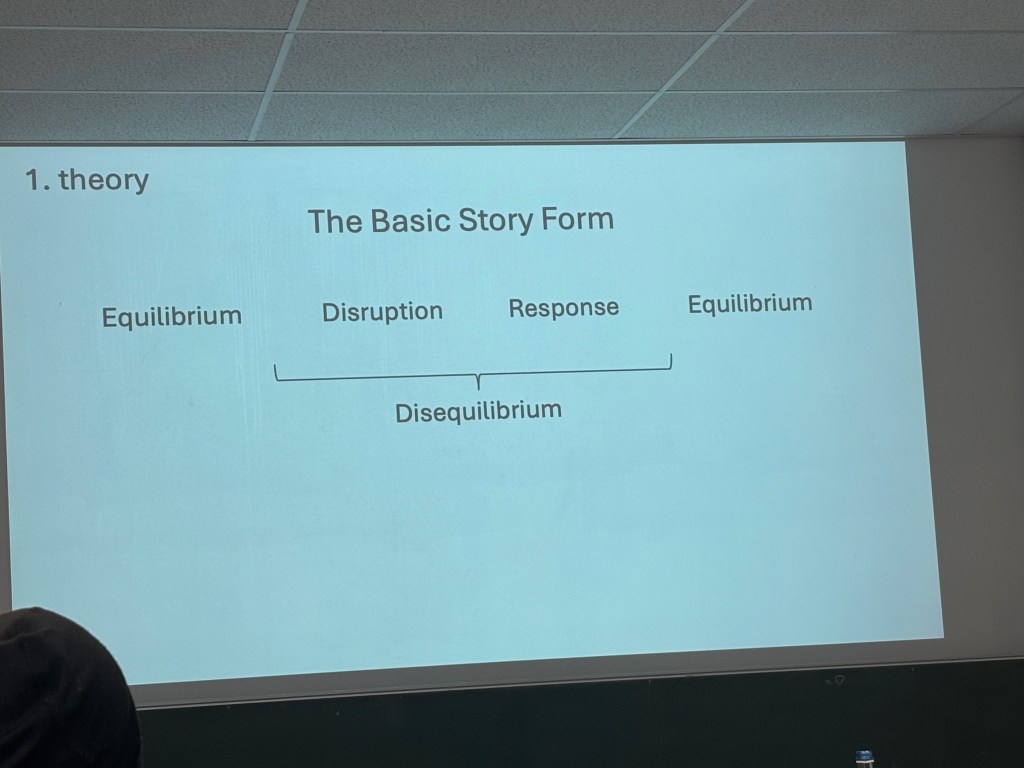
The third day of the conference started with James Cutting’s presentation on the basic form of stories. I like his book Movies on Our Minds and how he combines basics, such as types of shots and transitions, with a deep understanding of the evolution of film style, as well as how he works with empirical data. This was the first time I had seen him live. And in a similar way as in his book, Cutting started with the basics – the form of a joke – and continued with more and more complex stories (and not only stories) to show us that the “beginning – middle – end” form is repeated in many variations. Sometimes individual parts are divided into subsections, but the basic form is everywhere. I must say that this time I found myself missing an explanation as to why this is so surprising. I don’t doubt that stories might be segmented into smaller parts, but I don’t get the surprising point. Only in the subsequent discussion did the explanation emerge: that the segmentation into smaller parts might be caused by the demands of our memory. Then it makes sense and opens up possibilities for further research. But without an explanation like that, the segmentation itself feels more like a tool to understand individual stories, than a basic form shared across media and cultures.
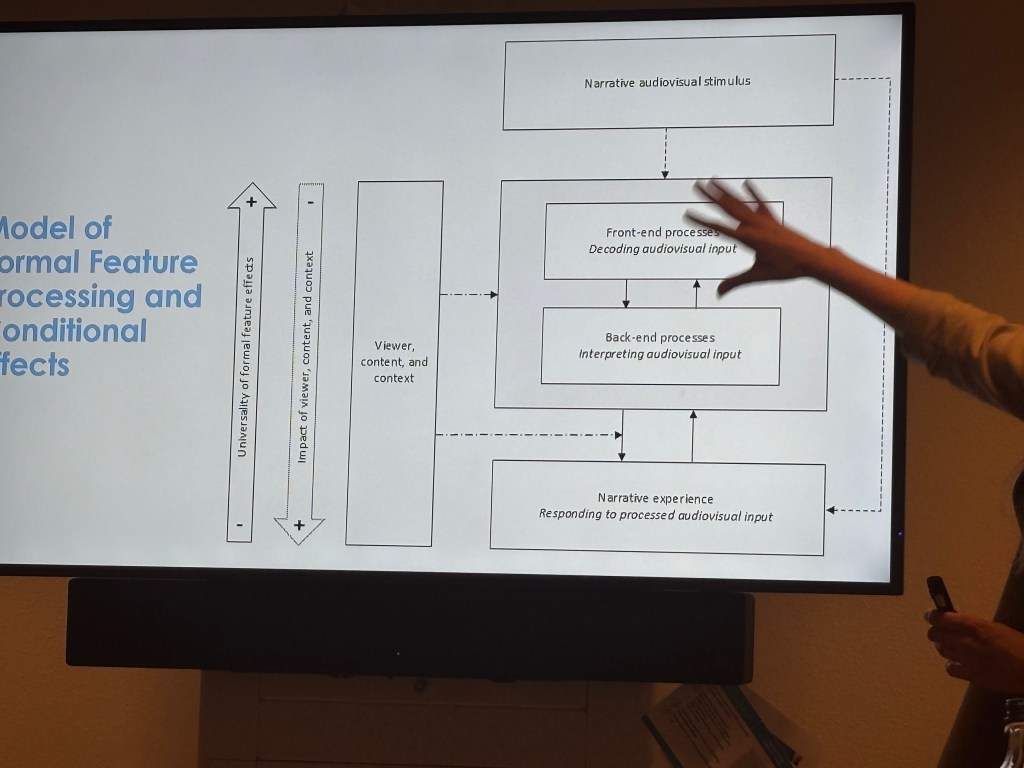
Furthermore, the conference offered many interesting papers focusing on the details such as an effect of single white frames in narrative films on perception (Javier Sanz-Aznar and Juan José Caballero-Molina), or overall theories such as model of film comprehension (Tess Lankhuizen and Katalin Bálint). What really fascinated me, however, was the panel discussion at the end of the day.
In the Author-Meets-Critics format, four panelists first commented on Malcolm Turvey’s book Film, Art, and the Limits of Science: In Defence of Humanistic Explanation. After that, Malcolm Turvey rebutted their arguments. To sum up the discussion, Turvey argued that some research questions might only be answered by means of the humanities and no scientific explanation is needed. His critics objected that it is hard to say in advance which explanation will be sufficient. Turvey and his critics all agreed that the humanities need to work with empirical evidence, have systematic methods, and ensure their findings are open to revision. I haven’t read the book, so my impression is only superficial, but… what is the point of keeping the humanities and science separated, when we wipe out the methodological differences? In this case, I don’t mean “method” as using machines. In this case, the scientific method means “falsifying hypotheses based on empirical evidence”. When this is the same for various disciplines, why do we need to draw a line between them? I suppose reading Turvey’s book will offer the answer.
The fourth day of the conference was pretty short for me. I needed to work, so I attended only two panels. In one of them, Carl Plantinga presented types of engagement from one chapter of his forthcoming book. Those types are obviously inspired by Daniel Kahneman’s System 1 and System 2 thinking. Partly, this can be understood as a possible solution to problems connected with the models of narrative engagement from previous days. In both models, the individual differences of viewers were mentioned as a problem. Cynthia Cabañas, co-author of the TENCo model, immediately suggested a possible way of integrating Plantinga’s types of engagement into her model by treating them as dynamically changing ways of engagement with film.


Leave a Reply