
The second day of the conference was mostly about narration for me, and how to think about it from a different perspective than what is usual in film studies. Traditional film form analysis is hard work, as a researcher needs to watch a film shot-by-shot or even frame-by-frame and manually code elements like shot size, type of shot, composition, staging, and transitions on one level. On another level of analysis, the researcher needs to think about patterns and the structure of the plot. This approach can be very effective when we want to understand how stories are constructed in cinema, but as you can imagine, it takes a lot of time and effort, and it is very demanding to cover a larger corpus of titles. Therefore, a computational breakthrough is needed.
First thing in the morning, Chiao-I Tseng and Matthias Springstein presented TIB-AV-A, their computational framework for analysing narrative patterns in films. They focus on shot sizes and characters within shots, and based on that, they were able to automatically identify several shot patterns in movies consisting of combinations of several shots. Their approach seems reasonable, especially given that there are many open-source Python libraries involving computer vision that can tell us a lot about the style of a film. When these are effectively combined, we can use computational analysis to understand some aspects of narration, too.
The second narration-focused paper was presented by Cynthia Cabañas. In her paper, she explored narrational complexity in relation to cognitive flexibility and tolerance for ambiguity. Building on the previously published TENCo model – involving cognition, affective response, appreciation of film, and individual traits – she tested if watching films causes shifts in cognitive processes. In another paper research by Gaia Yonah was based on the same model; she tried to develop and validate the Narrational Complexity Engagement (NCE) Scale – a questionnaire designed to assess engagement driven by complex narration.
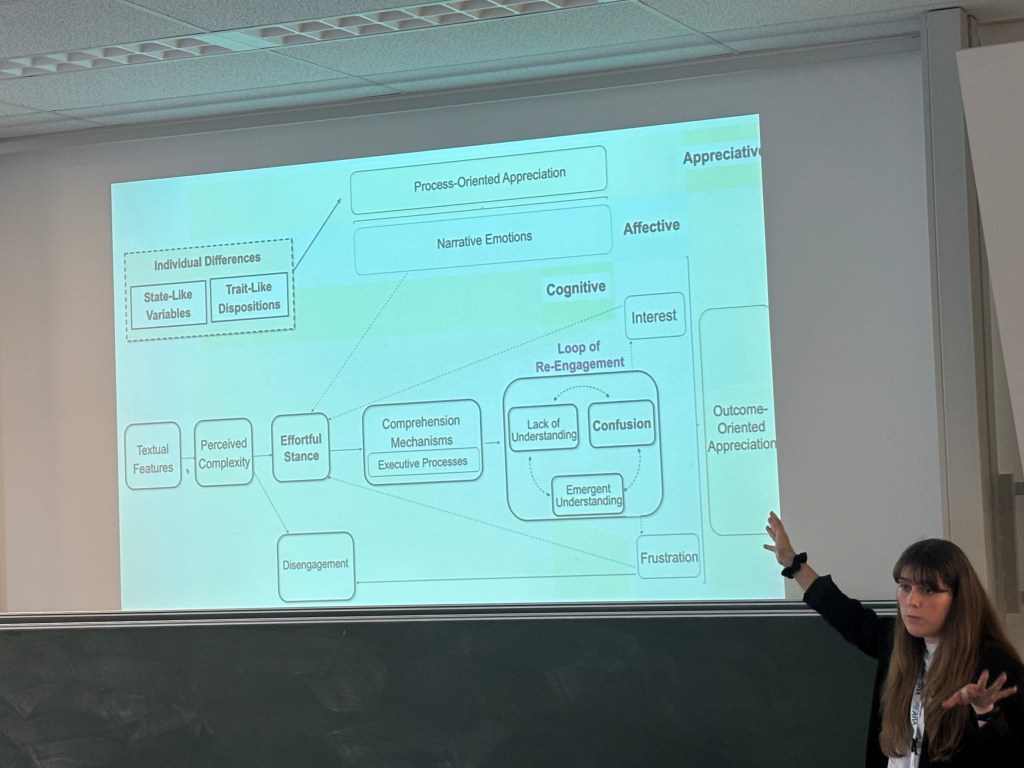
Computational and psychological approaches are getting closer to understanding what narration is and how it works on the level of film form and audience engagement. I believe this is the future of research in cinema. Maybe not exactly these specific examples, but methods and tools like those presented today.
The final panel was dedicated to the 30th anniversary of Ed Tan’s Emotion and the Structure of Narrative Film – Film As An Emotion Machine. Several scholars were remembering their first encounter with Ed Tan and his book, and in the end, Ed Tan looked back and recapitulated how our understanding of emotional responses has developed since the publication of his book. According to him, despite the great efforts of researchers, there is still an explanatory gap – the one David Chalmers calls the “hard problem of consciousness.” Subsequently, Ed Tan suggested involving a phenomenological approach in cognitivist research to address the subjective quality of these experiences. While I understand his concern about understanding subjective feel of emotions, my impression is that the whole SCSMI conference is full of examples showing that we understand the mechanisms of emotions better and better. It reminded me of Daniel Dennett’s From Bacteria to Bach and Back, where he opposes Chalmers and argues that consciousness (and arguably the explanatory gap itself) can be resolved when the easy problems are taken apart and studied gradually – in a similar way how computational analysis and cognitive psychology works. I guess that emotional reactions to films can be solved in a similar, progressive way.
Furthermore, there was a poster session today. Six posters were presented, and participants of the conference voted for the best one. The final ranking was:
- Lucía Cores-Sarría, Cynthia Cabañas: Familiarity Influences Physiological Arousal and Narrative Engagement During Short-Form Audiovisual Viewing
- Go Furusawa, Hideaki Kawabata, Tim J. Smith: Audiovisual Tempo Effects on Attention and Affect: A Cross-Cultural Investigation
- Jan Černík, Adam Ganz, Szonya Durant: Battle for Attention: Cognitive Mechanisms and Film Form in Second-Screen Viewing
So, third place for our poster! Not bad when I realise that this was my first experience with an academic poster since I was an MA student.


Leave a Reply