
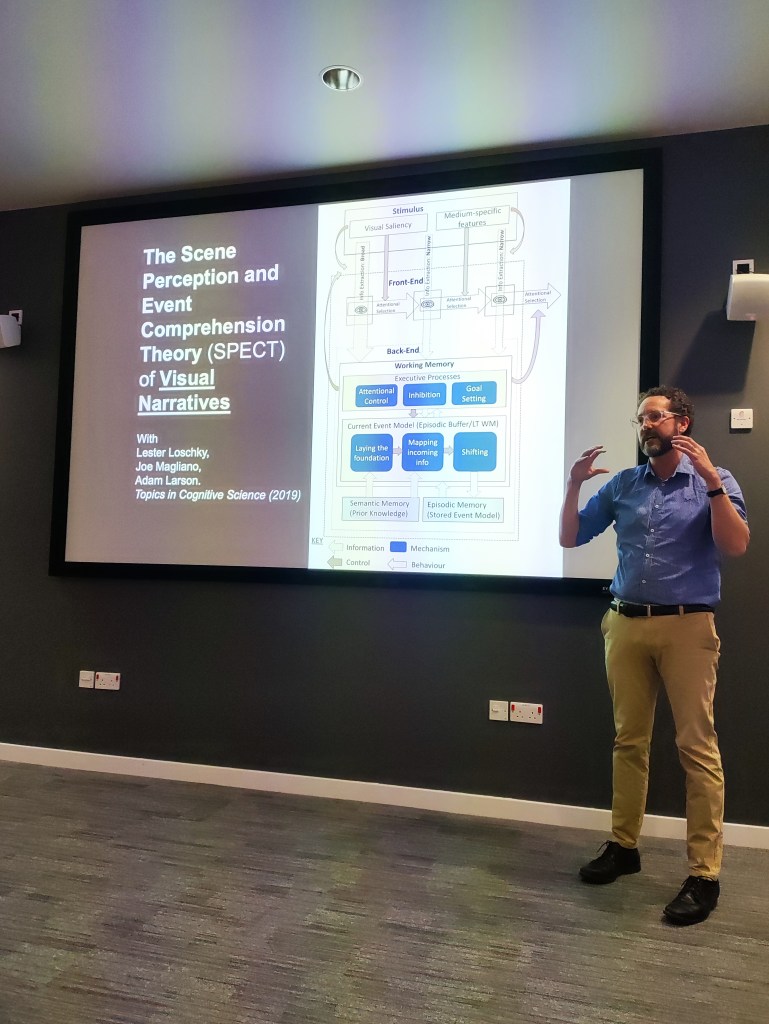
On Thursday, May 15, 2025, we welcomed Tim Smith from the University of the Arts in London to CoSTAR National Lab. Tim was kind enough to accept the invitation from Adam Ganz and me.
In his lecture, he talked about Continuity Editing Rules and why we, as viewers, enjoy watching (mainly) Hollywood movies so much. He also discussed how filmmakers control the audience’s attention. According to Tim Smith, filmmakers are brilliant intuitive psychologists. Without scientific knowledge of human cognition, they are able to very successfully control where viewers look in films and how they perceive them. He illustrated this with a range of data from his experiments.
I have been familiar with Tim’s work for many years. I mention several of his experiments and findings to my student in cognitive film theory classes. However, two things never occurred to me.
1) Tim refers to almost no film theorists. The exceptions are Janet Staiger, Kristin Thompson, and David Bordwell. He finds much more inspiration in the work of cognitive psychologists (J. J. Gibson, Daniel Simons, Joseph Anderson), neuroscientists (Uri Hasson), and especially filmmakers, whom he quotes extensively (Spielberg, Tarantino, Dmytrik, Eisenstein).
2) How much he loves film. He is genuinely fascinated by film and has a vast knowledge and passion for cinema.
I had the opportunity to talk to Tim before and after the lecture, and I was pleased by his vision of an ever closer connection between filmmakers and cognitive film studies. However, we also briefly touched on the topic of TikTok as a competitor to Cinematic Continuity in the battle for audience attention. So perhaps the main question is what form film will take in the future.
Exploring the Cognitive Foundations of Cinematic Continuity
Professor Tim Smith (University of the Arts London)
Thursday 15th May, 16:00
SHILLING-LT (Shilling building, Royal Holloway)
Filmmakers tell stories by selecting and emphasizing key details of an audiovisual scene through editing, cinematography and sound design. Such edited sequences instantaneously transport the viewer through space and time in ways that are physically impossible and, due to their divergence from reality should pose problems for viewer comprehension. However, filmmakers believe they have at their disposal a suite of editing techniques, known as the Continuity Editing Rules that make the viewing of film effortless. In this talk I will present a series of behavioural and eye tracking experiments investigating the cognitive foundations of film perception and provide a theoretical and methodological framework for extending filmmaker insights into audience experiences of film.
Tim J. Smith BSc. PhD. is Professor of Cognitive Data Science in the Creative Computing Institute, University of the Arts London and head of the Cognition in Naturalistic Environments (CINE) Lab. He applies empirical, computational, neuroscientific and developmental methods to questions of Media Cognition, including real-time audience experience analysis via eye tracking. He has published widely on the subject both in Psychology and Media journals and his research has informed media practices through collaborations with Dreamworks Animation, BBC, Channel 4, and the Academy of Motion Picture Arts and Sciences.Currently he is leading the UKRI cross-council multi-site research project, Animating Minds: Triangulating the age-appropriate impact of children’s media.
 SNAPlab
Leave a comment