
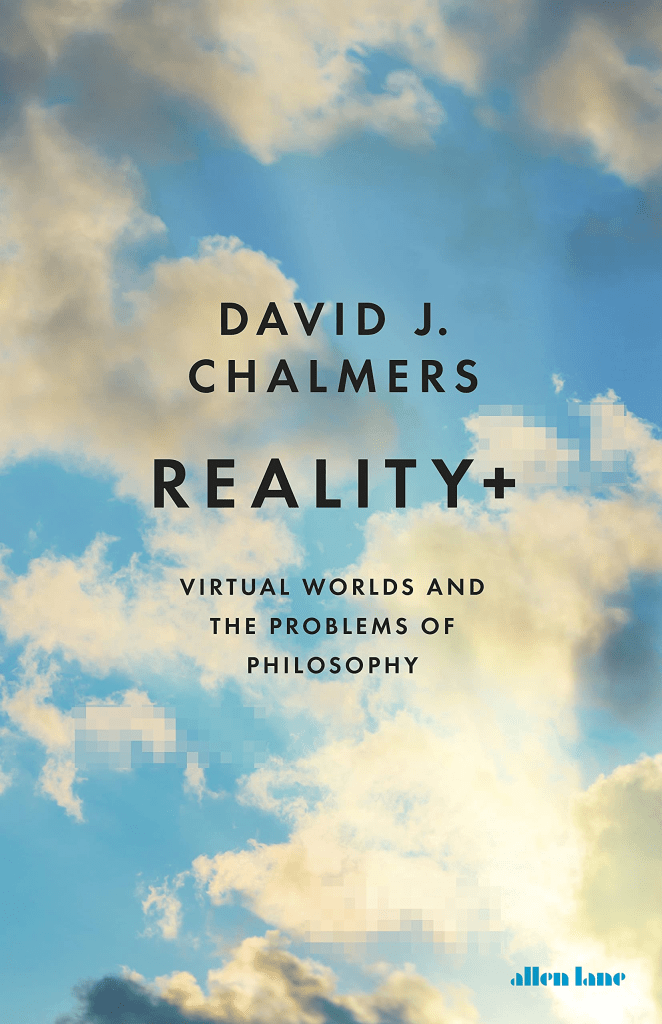
I decided to mix my reading about TikTok, social networks and cognitive psychology with a few philosophical books. In the case of Chalmers in particular, I initially felt that I might not be too far off thematically since he addressed the topic of virtual reality in his last book. Well, I was a bit mistaken. Chalmers has very different interests than I do, and he clearly tends to address problems of ontology, epistemology and ethics. In the context of TikTok, especially in the context of the current debate about whether or not to ban it, I found only one passage explicitly related. But I want to comment briefly on the rest of the book too.
First of all, it’s absolutely brilliantly written. In fact, I can well enough imagine that if this was what teaching philosophy in high schools was like, philosophy would have a very different reputation. Chalmers not only displays a deep erudition in Western philosophy, but also makes excursions into the non-Western philosophical tradition and especially into pop culture (especially science fiction literature, but also films such as The Matrix, The Thirteenth Floor, The Truman Show or series such as Star Trek: The Next Generation). Thinking about and through virtual reality (at least in the form of thought experiments) then leads him to rethink many philosophical concepts. Some of these – Plato’s Theory of Forms or the theistic conception of the world – are rather bizarre in the tradition of naturalised analytic philosophy. Chalmers approaches all of them with an open mind and is willing to grant them some persuasiveness in the context of his argument. If one of the functions of philosophy is to open minds and develop critical thinking, here it succeeds perfectly.
But now to the chapter on Value, where I find several points to consider in the case of the current discussion of TikTok. Recall that a few weeks ago it looked like TikTok was going to be banned in the US, then it didn’t even run for half a day before the new US President decided that things might be quite different. The case is summarized on wikipedia. What I found most interesting about the discussion was how the arguments for the ban were layered. We could see a diverse range of opinions covering national security, data protection, but also the dangers of TikTok for child users. I’m not competent to judge the extent to which TikTok can endanger America or damage the minds of children, and I don’t get the impression that there is a consensus on this. Let’s leave aside the legal, political and social dimension of the debate and think about whether TikTok has any value to the individual. Specifically, then, I will consider four possible values that Chalmers considers in the context of virtual reality.
In the chapter, Chalmers works with four traditional approaches to what it means that something is good for someone: hedonism, desire-satisfaction, social, and objective-list. Let’s look at what these approaches tell us about TikTok.
First, hedonism, which can simply be understood to mean that a thing is good if it brings more pleasure than pain. This is a bit of a problem with TikTok in particular. It brings satisfaction to its users which can result in addiction in 5.9 % of users. but for some individuals this can lead to a destructive, daily interaction with an app that satisfies them but potentially develops mental illness in some users as suggested by meta analysis.
Second in line is desire-satisfaction, or the approach that argues that a good life is one that brings about the fulfillment of our desires. Here we do not get simple hormonal satisfaction in the brain causing addiction to TikTok, which would again be contrary to a good and worthwhile life. Desire-satisfaction is probably the most advocated approach to value, promoted by the users themselves. Certainly not all of them, but a significant portion of them. Desire-satisfaction is implicitly present in all the motivational self-help videos, investment videos and exercise videos that are on TIkTok. I can’t judge whether this approach to values is correct, but TikTok, and by extension other social networks, are the venues through which desire-satisfaction spreads. And it only spreads because it finds a response from users who are willing to spend money on manuals, consultants and coaches to help them achieve financial independence, mental stability and a beautiful body.
The social perspective argues that the value lies in connecting with other people. Although social networks are often criticized for distancing people and creating moats in society, they are undoubtedly a tool that allows each of us to be in touch with family and friends at almost any time. For example, I can stop typing now and ask my wife Kristýna how many of her friends she has communicated with on social media today. The question is whether TikTok, which is primarily for sharing videos, offers social value. Here, though, it may just be a generational issue. While I wouldn’t be able to use videos to communicate operationally because I would be thinking through the angle, composition, and exact script of what I’m saying, some of my students already talk about making videos online as something natural. So at the very least, I don’t want to deny TikTok a social dimension. On the other hand social interaction is via TikTok and not with TikTok. Interaction with app and deep scrolling are understood as destructive practices.
And finally, the objective-list, which is the most subjective of all approaches. Even if we agree that the values are knowledge, friendship, and fulfillment (as Chalmers writes), we can never agree on whether TikTok helps us towards or away from those values. Whether TikTok serves an educational function is disputed (are student questionnaires a relevant method when we consider, that they may be already addicted to TikTok?), and whether the friendships on TikTok are real is also hard to agree on. I, for one, may be convinced that TikTok does not belong in the hands of children, but that does not mean that contact with TikTok will automatically damage their brains. In doing so, I feel that the current discussion about banning TikTok is being conducted on a moral level through the most vague objective-list approach to values.
In conclusion, let me just summarize that from an individual perspective, TikTok does not strike me as a fundamentally immoral application. Of course it has risks, of course its use can be dangerous for certain groups, but we could probably say that about all social networks or tools in general (guns, cars, staircases). I hope the political and social arguments of the proponents of banning TikTok are more convincing.
And if we look away from TikTok and look at short videos in general, their value is no less than that of other forms of audiovisual (information, advertising, communication, entertainment, or even art…). The problem is obviously in the platforms and may remind us of the critical perception of Hollywood. But this means that banning one platform won’t solve anything, because people will find another, as happened with the migration of Americans to Red Note.

 SNAPlab
Leave a comment