
A few years ago, when I joined Palacký University as an assistant professor, I started to include more and more cognitive theories in my teaching. After five years I have to say that I feel a positive response from the students. Every year there are several of them who want to explore film audiences and their perception of cinema. And this semester, the best student thesis so far was submitted: The Body in the Film (original title: Tělo ve filmu).
I’ve selected a few of the most compelling findings from the thesis, which I’d like to briefly share here. They offer fascinating insights into how composition, gender, and viewer attention interact.
Gendered perception of male nudity: In a scene featuring male masturbation from the film Její tělo, male viewers paid significantly less attention to the nude male body than female viewers did (pp. 25–26).
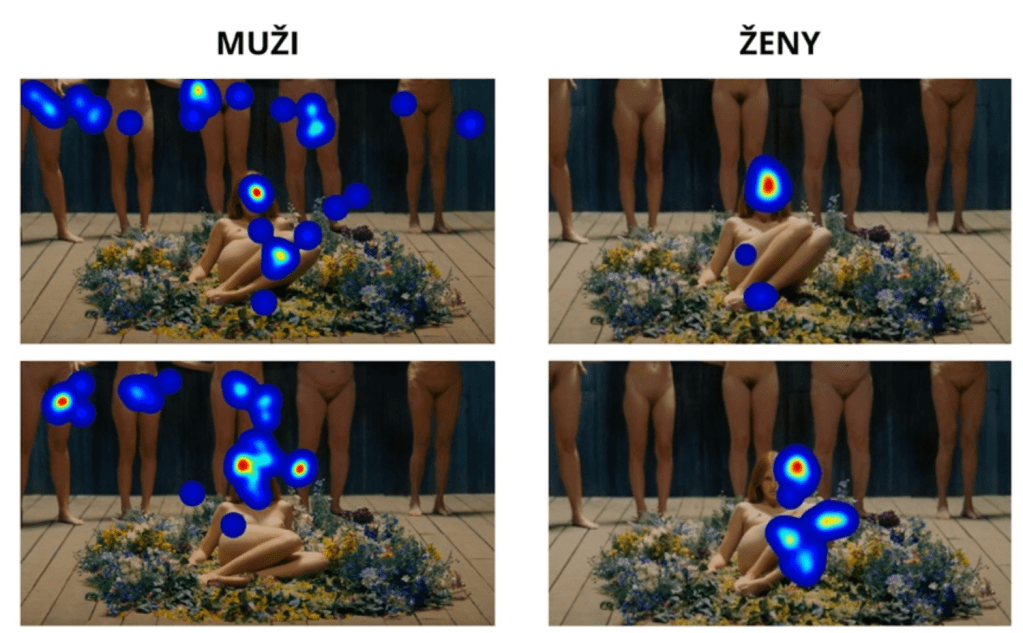
Gendered perception of nudity in centre and periphery: During the ritual sex scene in Midsommer, women focused primarily on the central action of the narrative, while men’s attention was often drawn to exposed female genitalia (pp. 27–28).
Fluctuating focus in Chyby: When nudity is shown, viewers’ attention shifts back and forth between the characters’ faces and the exposed female breasts. These shifts are driven by changes in dramatic tension and the unfolding dialogue – especially while revealing the characters’ past (pp. 27–28).
Focused attention in Poor Things: A combination of lens choice, actor movement, and color palette effectively guides viewers to concentrate solely on the actors, largely ignoring the surrounding space (pp. 29–30).
Visual suppression in Její tělo: In a visually distinct static shot from the film Její tělo, careful use of composition, low lighting, and actor performance causes viewers to almost completely disregard a striking neon-blue sign and a red light source in the background—even though they are visually prominent (pp. 31–32).
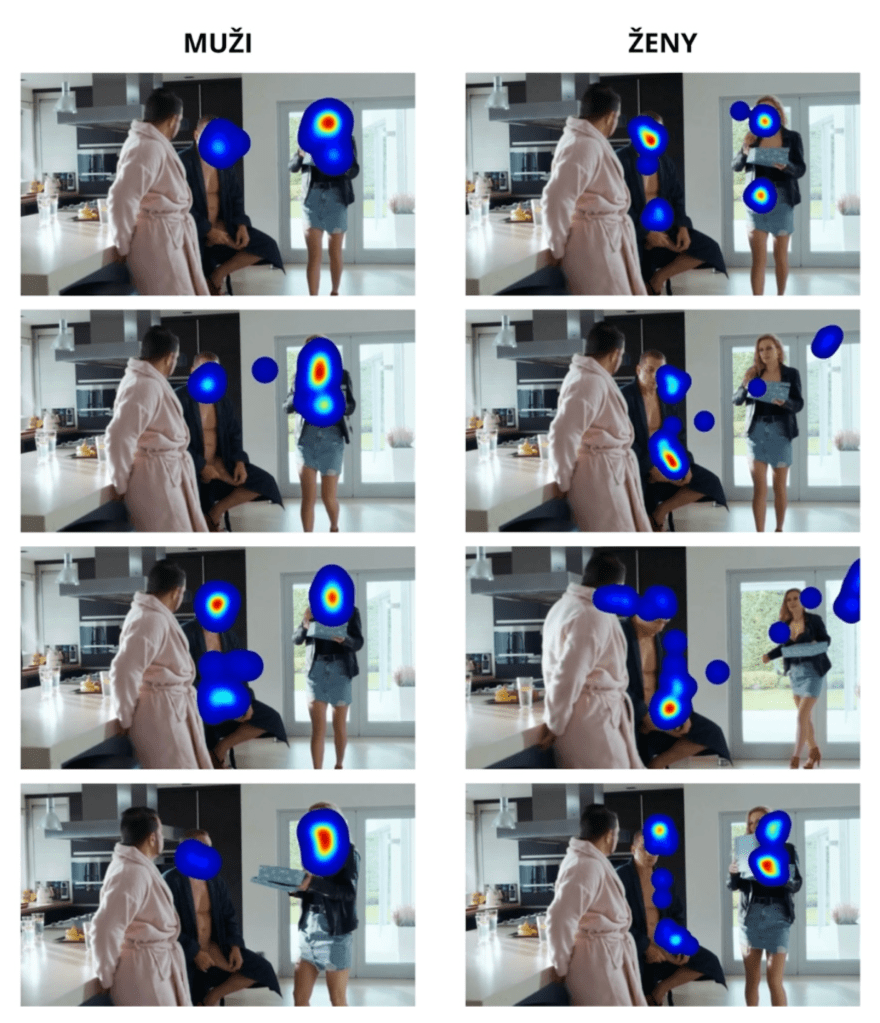
Gendered gaze dynamics: Across various scenes, the analysis found that male viewers tended to fixate longer on sexualized body parts, while female viewers perceived scenes more holistically—often focusing on the emotional and relational dynamics between characters.
Involuntary attention: One of the most striking findings is that viewers look at nudity even when they consciously try not to. Their gaze reveals an unconscious attention pattern that contradicts their self-reports (p. 54).
 SNAPlab